D6010 Dental Code: Implant Placement & Billing Guide
Dental implant billing confuses many patients and even some front-office teams. One code causes more questions than almost any other: D6010. This guide breaks down exactly what the D6010 dental code means, when dentists use it, and how it affects your insurance claim. You’ll learn what the code covers, what it excludes, and how to avoid the billing mistakes that lead to denied claims. Whether you’re a patient trying to understand your treatment plan or a dental team member refining your coding workflow, this article gives you a clear, practical reference for D6010.
What Is the D6010 Dental Code? Understanding Endosteal Implant Placement
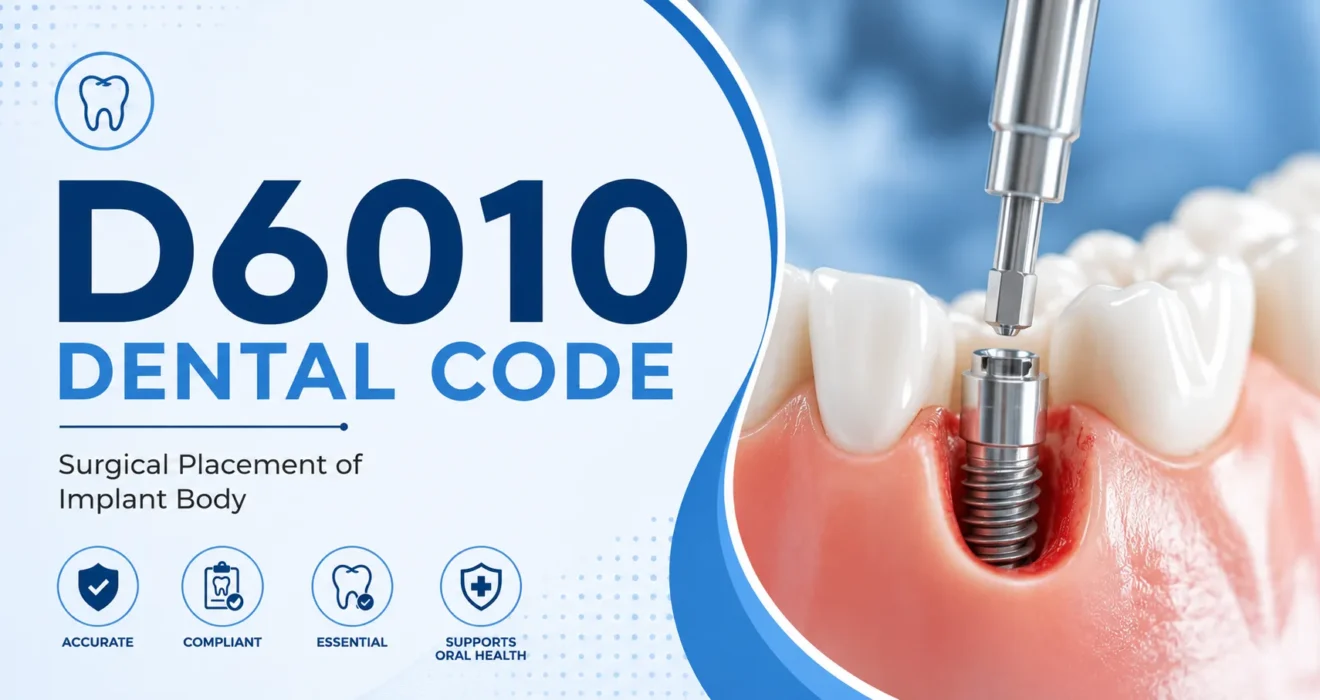
The D6010 dental code identifies a specific surgical procedure within the American Dental Association’s Current Dental Terminology (CDT) system. Dentists use this code to bill for the surgical placement of an endosteal implant body. In simple terms, it covers the moment a clinician inserts a titanium or titanium-alloy post directly into the jawbone. This post functions as an artificial tooth root and forms the foundation for everything that follows in implant treatment.
Patients often assume this single code covers their entire implant journey. It doesn’t. The D6010 dental code applies strictly to the surgical insertion stage. It does not include the healing abutment, the final abutment, or the crown that eventually attaches on top. Each of those later stages carries its own separate CDT code, and insurers track them independently.
The procedure itself involves several clinical steps. A dentist or oral surgeon administers local anesthesia, makes an incision in the gum tissue, and prepares the bone site through a careful drilling process called osteotomy. The implant body then gets placed into that prepared site, and the tissue is closed around it. Healing follows over the next several months as the bone fuses to the implant surface.
This fusion process, known as osseointegration, determines the long-term success of the implant. Dentists typically wait three to six months before moving to the next surgical or restorative phase. During this healing window, the implant essentially becomes part of the jawbone structure. Modern implant success rates exceed 95 percent when an experienced practitioner performs the placement correctly.
Dental teams bill D6010 once for every individual implant placed. A patient receiving three implants in different areas of the mouth generates three separate D6010 claims, each tied to its own tooth number. This per-site billing structure matters enormously for insurance reimbursement, since most plans apply benefit limits on an individual implant basis rather than a per-visit basis.
Understanding this code matters for anyone navigating implant treatment. Patients who recognize what D6010 actually represents can ask sharper questions about their treatment plan and total costs. Dental staff who code it correctly protect their practice from denied claims and costly rework. The sections below walk through coverage details, clinical use cases, billing strategy, and the related codes that frequently get confused with D6010.
What D6010 Covers — And What It Doesn’t
Knowing the exact boundaries of this code prevents billing errors before they happen. Insurance examiners reject claims quickly when a code doesn’t match the documented procedure, so precision here protects both the practice and the patient’s wallet.
What the D6010 Dental Code Includes
The surgical placement procedure bundled under D6010 covers several components automatically:
- Local anesthesia administered for the implant surgery
- The surgical incision and flap reflection
- Osteotomy preparation of the implant site
- Insertion of the standard, full-sized endosteal implant body
- Surgical closure of the site after placement
What D6010 Does Not Include
Several related procedures require their own separate codes and cannot be folded into a single D6010 claim:
- The healing abutment placed during a two-stage protocol
- The final abutment that connects the implant to the crown
- The implant crown or prosthetic restoration itself
- Bone grafting performed at the same surgical visit
- Mini-implants, which use a different, narrower-diameter code
Why the Distinction Matters
Billing teams that overcode or undercode this procedure invite trouble. Submitting D6010 as if it covers the crown, for example, almost guarantees a denial once the insurer reviews supporting documentation. On the other hand, failing to bill bone grafting separately when it actually occurred means the practice loses legitimate, billable revenue. Clear, accurate separation between these procedures keeps claims clean and reimbursement timely.
When Dentists Should (and Shouldn’t) Use D6010
Clinical context determines whether D6010 is the correct code for a given patient visit. Using the right code at the right stage of treatment prevents downstream coding conflicts and keeps the patient’s benefit history accurate.
Appropriate Clinical Scenarios for D6010
Dentists typically apply this code in the following situations:
- A patient is missing a single tooth and has adequate bone volume to support a standard implant.
- Multiple implants are needed to restore several missing teeth in the same arch.
- Implants are being placed as anchors for a future full-arch or denture restoration.
- The patient has already completed any necessary bone grafting and now qualifies for standard implant placement.
- The implant being placed is full-sized and root-form, not a narrow mini-implant.
Situations Where a Different Code Applies
Dentists should avoid D6010 and select an alternative code in these cases:
- When placing a mini-implant, code D6013 applies instead.
- When performing second-stage surgery to access an already-placed implant, code D6011 is correct.
- When inserting an interim implant body for a transitional prosthesis, D6012 fits the scenario.
- When the procedure involves endodontic endosseous implants rather than standard implant bodies, D3460 may apply.
Selecting the wrong code in any of these scenarios increases the chance of an audit flag or an outright claim rejection. Dental teams should always match the code to the documented clinical reality, not to whichever code seems simplest to bill.
D6010 Billing, Documentation, and Insurance Reimbursement Tips
Strong documentation makes the difference between a smooth reimbursement and a frustrating denial cycle. Insurance carriers scrutinize implant claims more heavily than almost any other dental procedure, largely because many plans classify implants as elective rather than essential care.
Documentation Every D6010 Claim Should Include
Dental teams should attach the following before submitting any D6010 claim:
- Pre-operative radiographs or CBCT scans showing the edentulous site and surrounding bone quality
- A detailed clinical narrative explaining why the implant is medically necessary
- The exact tooth number corresponding to the implant site
- Periodontal charting or missing-tooth history that supports the treatment decision
- Post-procedure notes documenting the outcome and any follow-up plan
Verifying Benefits Before Treatment
Practices that verify coverage before the surgical appointment avoid the most painful billing surprises. Many dental plans apply an alternate benefit clause, which limits reimbursement to the cost of a less expensive restoration, such as a three-unit bridge, even when the patient chooses an implant. Some plans also set a separate annual maximum specifically for implant procedures, distinct from the general yearly benefit cap.
Front-office staff should ask the insurer directly whether D6010 is an active covered service, what percentage of the cost falls under “major services,” and whether any waiting period applies. Confirming these details in writing before the surgery date gives the patient accurate cost expectations and reduces billing disputes after treatment.
Handling Common Denials
When a D6010 claim gets denied, the resolution usually depends on the stated reason. A denial citing missing documentation typically requires resubmission with clearer radiographs and a stronger clinical narrative. A denial claiming the procedure was “bundled” into another surgical service often requires a direct reference to the CDT descriptor language, demonstrating that D6010 covers the implant body placement alone and not any auxiliary bone work performed at the same visit.
D6010 vs. Similar Implant Codes: Avoiding Common Mix-Ups
Dental coding includes dozens of closely related implant codes, and mixing them up is one of the most frequent billing errors in implant dentistry. Even experienced billing staff occasionally confuse these codes, especially when a treatment plan spans multiple visits and surgical stages.
D6010 vs. D6011
D6011 covers second-stage implant surgery access, which happens after the implant has already integrated into the bone. D6010, by contrast, applies only to the initial surgical placement. These two codes should never appear on the same claim for the same surgical visit.
D6010 vs. D6013
D6013 applies specifically to mini-implants, which use a narrower diameter than standard implants. Billing D6010 for a mini-implant placement is considered overcoding and can trigger compliance concerns during an insurance audit.
D6010 vs. D6104
D6104 covers bone grafting performed at the same time as implant placement. These two procedures frequently occur together, but they always require separate codes. A typical claim might list D6010 for the implant body and D6104 for the graft material placed around it during the same surgical session.
D6010 vs. D6056/D6057
These abutment codes apply to the connector piece that links the implant to the eventual crown. They represent an entirely different phase of treatment and should never be billed alongside D6010 for the same surgical date, since the abutment placement happens months later, after osseointegration is complete.
Conclusion
The D6010 dental code represents one specific, well-defined moment in implant treatment: the surgical placement of the implant body into the jawbone. It excludes the abutment, the crown, and any bone grafting performed separately. Dentists bill it once per implant site, and insurers evaluate it under strict documentation requirements before approving reimbursement.
Patients benefit from understanding this code because it clarifies why implant treatment plans list several separate charges rather than one bundled fee. Dental teams benefit because accurate use of D6010 reduces denials, speeds up reimbursement, and keeps the practice compliant during insurance audits. Getting this single code right — and knowing exactly where its boundaries sit — makes the rest of implant billing far easier to manage.