D4381 Dental Code: Complete Billing & Coding Guide
Periodontal disease rarely resolves with a single visit, and sometimes scaling and root planing alone isn’t enough to calm a stubborn pocket. That’s where the D4381 dental code comes in. It covers a targeted, in-office treatment that delivers medication straight to an infected gum pocket instead of relying on pills the patient swallows at home. For dental teams, knowing exactly when and how to bill this code is the difference between a smooth reimbursement and a frustrating denial. This guide breaks down what the code means, when it applies, what insurers want to see, and how it compares to similar periodontal codes — all explained in plain language your front desk and billing team can put to use right away.
What Is the D4381 Dental Code?
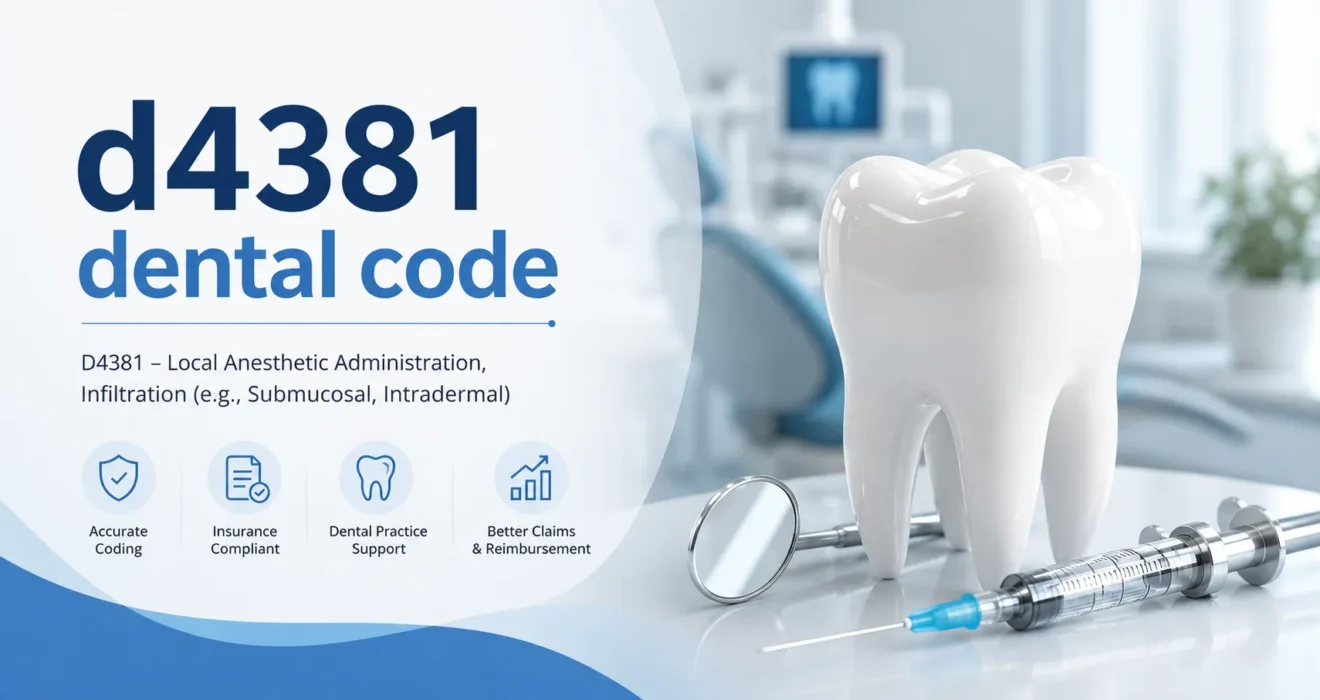
D4381 stands for “localized delivery of antimicrobial agents via a controlled release vehicle into diseased crevicular tissue, per tooth.” In simpler terms, it describes placing an FDA-approved antimicrobial product, such as a chlorhexidine chip or a minocycline gel, directly into a periodontal pocket. Common brand names dentists use under this code include Arestin, PerioChip, and Atridox.
The agent doesn’t dissolve instantly. It’s built into a slow-release vehicle so the medication stays active at the treatment site for an extended period. That sustained exposure helps suppress the bacteria responsible for ongoing inflammation, giving the gum tissue a real chance to heal between cleanings.
This code falls under the periodontics category of the CDT code set, and it sits specifically in the periodontal surgery and non-surgical periodontal treatment range. It’s billed per tooth, not per site and not per quadrant, which trips up a lot of billing teams who are used to quadrant-based periodontal coding.
D4381 is not a stand-in for standard oral antibiotics, and it isn’t meant to replace routine irrigation during a cleaning. Insurance reviewers watch for this distinction closely, since misapplying the code is one of the fastest ways to trigger an audit or a flat denial.
Most payers expect D4381 to follow, not replace, conventional periodontal therapy. It typically shows up after scaling and root planing when certain pockets simply refuse to shrink. The code exists for that narrow, persistent-pocket scenario rather than as a first-line treatment.
Because the procedure is so specific, dental teams that understand the nomenclature word for word tend to file cleaner claims. Knowing the code inside and out also helps when explaining treatment, and cost, to patients before the procedure happens.
When Should Dental Practices Use D4381?
Not every gum pocket calls for localized antimicrobial therapy, so timing and clinical justification matter just as much as the procedure itself.
The Clinical Picture That Supports D4381
Dentists generally turn to this code when a patient shows specific, well-documented signs of ongoing periodontal infection. Reviewers look for a pattern, not a one-off measurement.
- Periodontal pockets that measure 5mm or deeper after initial therapy
- Pockets that persist or return after scaling and root planing
- Bleeding on probing or other active inflammation at the site
- A medical history that makes systemic antibiotics or osseous surgery less suitable
- A documented gap of roughly four to six weeks between active therapy and this treatment
Patients Who Typically Qualify
Refractory periodontitis cases are the classic example: patients who completed scaling and root planing, returned for a periodontal maintenance visit, and still show isolated deep pockets. Patients with conditions like diabetes or cardiovascular disease, where surgery carries added risk, are also frequently good candidates, since D4381 offers a less invasive alternative.
It helps to mention the possibility of this treatment during the original scaling and root planing appointment. That way, if the pocket doesn’t respond as hoped, the patient already understands why a follow-up procedure might be recommended at their next periodontal maintenance visit.
Documentation You Need for a Clean D4381 Claim
Insurers reimburse D4381 inconsistently, and incomplete records are the single biggest reason claims get rejected or downgraded. Solid documentation removes most of that risk.
Before submitting a claim, make sure the chart includes the following, in this order:
- Exact tooth number and treatment site for every location where the agent was placed
- Pocket depth measurements recorded both before and after the prior periodontal therapy
- A clear clinical narrative explaining why the pocket didn’t respond to scaling and root planing alone
- The name, lot number, and quantity of the antimicrobial agent used
- Dates of all related treatment, including the earlier scaling and root planing visit
- Supporting diagnostics, such as periodontal charting, radiographs, or probing records
Skipping even one of these items gives a reviewer an easy reason to deny the claim. Many practices now build a simple checklist into their charting software so nothing gets left out before the claim goes out the door.
Billing Tips to Avoid D4381 Claim Denials
Even with perfect documentation, a few billing habits make a real difference in how often D4381 claims get approved on the first pass.
Always request pre-authorization whenever the patient’s plan allows it. Submitting periodontal charting and treatment history in advance gives the payer a chance to flag concerns before the procedure happens, rather than after.
Bill strictly per tooth, never per quadrant or per arch. Each treated tooth needs its own line on the claim, with its own supporting notes.
Coordinate the timeline with prior codes. If D4381 follows D4341 or D4342 (scaling and root planing), the claim should clearly show the sequence and the medical reasoning for the additional therapy.
Check pharmacy-benefit billing options. Some antimicrobial manufacturers bill the medication directly through the patient’s pharmacy plan, which can shift part of the fee away from the dental claim entirely.
Track every Explanation of Benefits. If a claim comes back denied or downgraded, file an appeal quickly with the missing documentation attached rather than letting it sit in accounts receivable.
D4381 vs. Other Periodontal CDT Codes
Confusing D4381 with a neighboring code is one of the most common coding mistakes in periodontal billing, so it helps to see the codes side by side.
D4381 is not the same as D4341 or D4342, which describe scaling and root planing itself. Those codes cover the mechanical removal of plaque and calculus; D4381 covers a medication placed afterward when the pocket hasn’t fully healed.
It’s also distinct from D4210, gingivectomy or gingivoplasty, which involves surgically reshaping gum tissue rather than delivering medication into it. If a pocket needs reshaping rather than medication, D4210 is the appropriate code instead.
Finally, D4381 shouldn’t be confused with D4910, periodontal maintenance. D4910 covers the ongoing recall cleanings periodontal patients need after active therapy, while D4381 is reserved for the specific moment a site still needs extra antimicrobial support. Understanding these boundaries keeps claims accurate and reduces the odds of an insurance audit down the road.
Conclusion
The D4381 dental code fills a very specific gap in periodontal care: it lets dentists treat a stubborn, localized pocket with targeted medication instead of jumping straight to surgery or systemic antibiotics. Used correctly, it gives patients with refractory periodontitis a less invasive path toward healing, and it gives practices a legitimate, billable way to follow through on that care. The key to getting paid for it consistently comes down to three habits: confirming the clinical criteria actually support the code, documenting every detail insurers expect to see, and double-checking that D4381 isn’t being mixed up with a similar-sounding code. Build those habits into your workflow, and D4381 claims become far less of a billing headache and far more of a routine part of comprehensive periodontal treatment.