
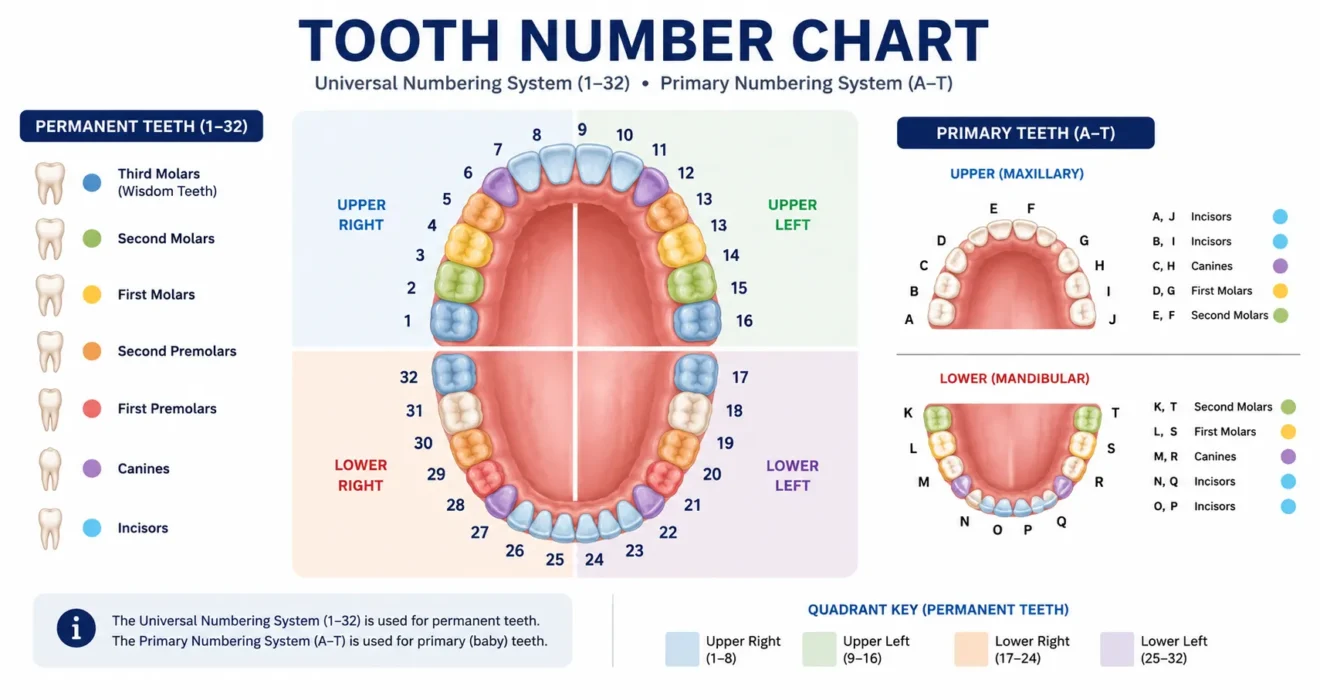
Tooth Number Chart: The Complete Guide to Understanding Dental Numbering Systems
Have you ever sat in a dentist’s chair and heard terms like “tooth number 14” or “upper left first molar” and wondered what they meant? You are not alone. Dental offices use a standardized tooth number chart to communicate precisely about every tooth in your mouth — and understanding this system can make your dental visits far less confusing. Whether you are a patient trying to decode your dental records, a dental student learning the fundamentals, or simply someone curious about how oral health professionals work, this guide will break down everything you need to know. From the Universal Numbering System used across the United States to the FDI World Dental Federation system used internationally, we cover it all in plain, easy-to-understand language.
What Is a Tooth Number Chart?
A tooth number chart is a standardized diagram used by dental professionals to identify and record information about each individual tooth. Rather than relying on vague descriptions like “back tooth on the top left,” dentists use a consistent numerical or alphanumerical code that points to one specific tooth every single time. This system forms the backbone of dental recordkeeping, treatment planning, and professional communication.
The importance of a tooth number chart extends far beyond the dentist’s office. When you need a dental X-ray, when your insurance company reviews a claim, or when you are referred to an oral surgeon or orthodontist, the tooth number chart serves as a universal language. It removes ambiguity and ensures that every professional involved in your care is talking about exactly the same tooth.
There are several numbering systems in use worldwide. In the United States, the Universal Numbering System is the standard adopted by the American Dental Association. Internationally, the FDI Two-Digit System (also called the ISO System) is widely used. Another system, the Palmer Notation Method, is popular among orthodontists and oral surgeons in many English-speaking countries. Each system has its own logic, its own strengths, and its own context of use.
Understanding your tooth number chart also empowers you as a patient. When a dentist says “we need to treat tooth number 19,” you can look at a chart and immediately know they are referring to your lower left first molar — one of the most important chewing teeth in your mouth. This knowledge helps you ask better questions, understand treatment plans, and take a more active role in your dental health.
The human mouth contains 32 permanent adult teeth and 20 primary (baby) teeth. Each of these teeth has a specific location, function, and name — and each has a corresponding number or code on the tooth chart. Learning to read this chart is one of the most practical things you can do to become a more informed dental patient.
Dental professionals are trained to use these charts from the very beginning of their education, and accuracy matters enormously. A mistake in tooth numbering on a dental chart can lead to the wrong tooth being treated — a situation that no patient or dentist ever wants to face. This is why the systems are so carefully standardized and why they are taught rigorously in every dental school.
The Universal Numbering System Explained
What Is the Universal Numbering System?
The Universal Numbering System (UNS) is the tooth numbering method officially adopted by the American Dental Association (ADA) and is the most commonly used system in the United States. It assigns a number from 1 to 32 to every permanent adult tooth.
How Does the Numbering Work?
The numbering starts at the upper right wisdom tooth (tooth #1) and moves across the top of the mouth from right to left, ending at the upper left wisdom tooth (#16). It then drops down to the lower left wisdom tooth (#17) and continues across the bottom from left to right, ending at the lower right wisdom tooth (#32).
Here is the sequence:
- Teeth #1–16: Upper (maxillary) arch, starting from upper right
- Teeth #17–32: Lower (mandibular) arch, starting from lower left
Adult Tooth Number Reference
Upper Right Quadrant (Teeth #1–8):
- #1 — Upper right third molar (wisdom tooth)
- #2 — Upper right second molar
- #3 — Upper right first molar
- #4 — Upper right second premolar
- #5 — Upper right first premolar
- #6 — Upper right canine (cuspid)
- #7 — Upper right lateral incisor
- #8 — Upper right central incisor
Upper Left Quadrant (Teeth #9–16):
- #9 — Upper left central incisor
- #10 — Upper left lateral incisor
- #11 — Upper left canine (cuspid)
- #12 — Upper left first premolar
- #13 — Upper left second premolar
- #14 — Upper left first molar
- #15 — Upper left second molar
- #16 — Upper left third molar (wisdom tooth)
Lower Left Quadrant (Teeth #17–24):
- #17 — Lower left third molar (wisdom tooth)
- #18 — Lower left second molar
- #19 — Lower left first molar
- #20 — Lower left second premolar
- #21 — Lower left first premolar
- #22 — Lower left canine (cuspid)
- #23 — Lower left lateral incisor
- #24 — Lower left central incisor
Lower Right Quadrant (Teeth #25–32):
- #25 — Lower right central incisor
- #26 — Lower right lateral incisor
- #27 — Lower right canine (cuspid)
- #28 — Lower right first premolar
- #29 — Lower right second premolar
- #30 — Lower right first molar
- #31 — Lower right second molar
- #32 — Lower right third molar (wisdom tooth)
Primary (Baby) Teeth Numbering on the Tooth Chart
How Are Children’s Teeth Numbered?
Children’s primary teeth — commonly called baby teeth or deciduous teeth — are numbered differently from adult teeth. In the Universal Numbering System, primary teeth use letters A through T rather than numbers.
Primary Tooth Letter Chart
The lettering follows the same directional pattern as the adult numbering — starting from the upper right and moving around:
- A — Upper right second primary molar
- B — Upper right first primary molar
- C — Upper right canine
- D — Upper right lateral incisor
- E — Upper right central incisor
- F — Upper left central incisor
- G — Upper left lateral incisor
- H — Upper left canine
- I — Upper left first primary molar
- J — Upper left second primary molar
- K — Lower left second primary molar
- L — Lower left first primary molar
- M — Lower left canine
- N — Lower left lateral incisor
- O — Lower left central incisor
- P — Lower right central incisor
- Q — Lower right lateral incisor
- R — Lower right canine
- S — Lower right first primary molar
- T — Lower right second primary molar
Other Dental Numbering Systems You Should Know
The FDI Two-Digit System
The FDI World Dental Federation System — also known as the ISO 3950 system — is used in most countries outside the United States. Instead of a single number, it uses two digits:
- The first digit identifies the quadrant (1 = upper right, 2 = upper left, 3 = lower left, 4 = lower right)
- The second digit identifies the tooth within the quadrant (1–8, from center to back)
For example: Tooth 36 = lower left first molar (quadrant 3, sixth tooth from the center)
For primary teeth, the quadrants are numbered 5–8 instead of 1–4.
The Palmer Notation Method
The Palmer Notation Method uses a bracket symbol and a number to indicate which quadrant and which tooth is meant. Originally created in 1891, this system uses numbers 1–8 for permanent teeth and letters A–E for primary teeth. A bracket symbol shows which quadrant the tooth belongs to:
- ⌐1 = upper right central incisor
- 1¬ = upper left central incisor
- L1 = lower right central incisor
- 1┘ = lower left central incisor
This system is especially popular among orthodontists and oral surgeons in the UK, Australia, and Canada.
Types of Teeth and Their Functions
Understanding the Four Types of Teeth
Every tooth in your mouth has a specific shape and serves a specific purpose. Knowing the types helps you understand why each tooth’s position on the tooth number chart matters.
1. Incisors (Teeth #7–10 and #23–26)
- Eight in total (four upper, four lower)
- Thin, flat, and sharp-edged
- Primary function: cutting and biting food
- Front and center in your smile
2. Canines (Teeth #6, #11, #22, and #27)
- Four in total, one in each corner of the mouth
- Pointed and strong
- Primary function: tearing food
- Also called cuspids or eye teeth
3. Premolars (Teeth #4, #5, #12, #13, #20, #21, #28, and #29)
- Eight in total
- Flat with ridges (cusps)
- Primary function: crushing and grinding food
- Located between canines and molars
4. Molars (Teeth #1–3, #14–19, and #30–32)
- Twelve in total (including wisdom teeth)
- Largest and flattest teeth
- Primary function: heavy grinding of food
- Most commonly treated for cavities
How to Read a Dental Chart Like a Professional
Reading a tooth number chart effectively involves understanding both the numbering and the symbols dentists use to record the condition of your teeth.
Common Dental Chart Symbols
Dental professionals mark each tooth with symbols to indicate its current condition:
- Red markings — existing dental work (fillings, crowns, etc.)
- Blue or black markings — areas needing treatment or observed issues
- X — tooth that has been extracted or is missing
- Circle — indicates a full crown
- Wavy lines — surface decay or a cavity present
Surfaces of Each Tooth
Each tooth has five surfaces, and dental charting notes which surface is affected:
- Mesial (M) — the side facing toward the center of the mouth
- Distal (D) — the side facing away from the center
- Occlusal (O) — the chewing surface (back teeth only)
- Buccal (B) — the cheek-facing side
- Lingual (L) or Palatal (P) — the tongue-facing side
Why the Tooth Number Chart Matters for Your Dental Health
The tooth number chart is not just an administrative tool — it plays a direct role in the quality of dental care you receive. Here is why it matters:
- Accurate recordkeeping: Every filling, extraction, crown, or root canal is recorded by tooth number in your permanent dental file
- Insurance processing: Dental insurance claims require specific tooth numbers — mistakes can lead to claim denials
- Specialist referrals: When you see a periodontist, orthodontist, or oral surgeon, they rely on your chart to understand your history instantly
- Legal and forensic use: Dental records, identified by tooth chart data, are used in forensic identification of individuals
- Continuity of care: If you move or switch dentists, your new provider can read your chart and understand your entire dental history without needing to repeat X-rays or examinations
Conclusion
The tooth number chart is one of the most important tools in modern dentistry — and understanding it puts you in a powerful position as a patient. Whether your dentist is using the Universal Numbering System, the FDI Two-Digit System, or the Palmer Notation Method, each system exists to create a common language between all dental professionals.
By learning how your teeth are numbered, you can better understand treatment plans, insurance paperwork, and conversations with specialists. You will know exactly which tooth is being discussed, what procedure is needed, and how to compare treatment options with confidence.
Healthy teeth start with informed patients. The next time your dentist mentions “tooth number 30” or “tooth 14 needs a crown,” you will not just nod — you will know exactly what they mean and why it matters.
Frequently Asked Questions (FAQs)
1: What tooth is number 14 on the tooth number chart?
Tooth #14 in the Universal Numbering System is the upper left first molar. It is one of the most important teeth in your mouth for chewing and is located in the upper left quadrant, behind the premolars. This tooth is commonly involved in root canals and crowns due to its heavy chewing function.
2: How many teeth does an adult have, and are they all on the tooth number chart?
A full set of adult teeth consists of 32 teeth, including four wisdom teeth (third molars). The Universal Numbering System accounts for all 32 teeth, numbered 1 through 32. However, many adults have their wisdom teeth removed, so it is common for a chart to show teeth #1, #16, #17, and/or #32 as extracted.
3: What is the difference between the Universal System and the FDI System?
The Universal Numbering System assigns a single number (1–32) to each permanent adult tooth and is the standard in the United States. The FDI Two-Digit System uses a two-digit code where the first digit identifies the quadrant and the second identifies the tooth within that quadrant. The FDI system is used in most other countries and is considered more logical by many dental educators because the code itself tells you where the tooth is located.
4: Do baby teeth use the same tooth number chart as adult teeth?
No. Primary (baby) teeth use a different coding in the Universal System — letters A through T rather than numbers 1–32. The same directional pattern applies (starting from upper right and moving around), but letters distinguish children’s dental charts from adults’ at a glance.
5: Why do dentists call out tooth numbers during an exam?
When a dentist performs a periodontal or cavity check, they call out tooth numbers and condition codes to a dental assistant who records the information in real time on the chart. This is the standard clinical protocol for building an accurate, complete dental record during each visit. You may hear codes like “pocket depth 3mm” or “MOD composite” along with a tooth number.
6: Can I read my own dental chart at home?
Yes, absolutely. You have the legal right to access your dental records, and most dental offices will provide a copy of your chart upon request. With a standard tooth number chart (widely available online or from your dentist), you can interpret which teeth have been treated, which surfaces have fillings, and which teeth are noted as missing or in need of care. Understanding your own dental chart is an excellent way to stay actively involved in your oral health.