Full Upper Arch Dental Implants Cost: What You’ll Pay in 2026
Losing all or most of your upper teeth can affect far more than your smile — it impacts how you speak, eat, and feel about yourself every single day. Full upper arch dental implants offer a life-changing permanent solution, but one question dominates every patient’s mind before they book a consultation: how much does it actually cost?
The truth is, full upper arch dental implants cost varies widely depending on several critical factors — from the technique used to your geographic location and the expertise of your dental surgeon. This comprehensive guide breaks down every cost component, compares your options, and helps you understand exactly what you’re paying for — so you can invest in your smile with confidence and clarity.
What Are Full Upper Arch Dental Implants?
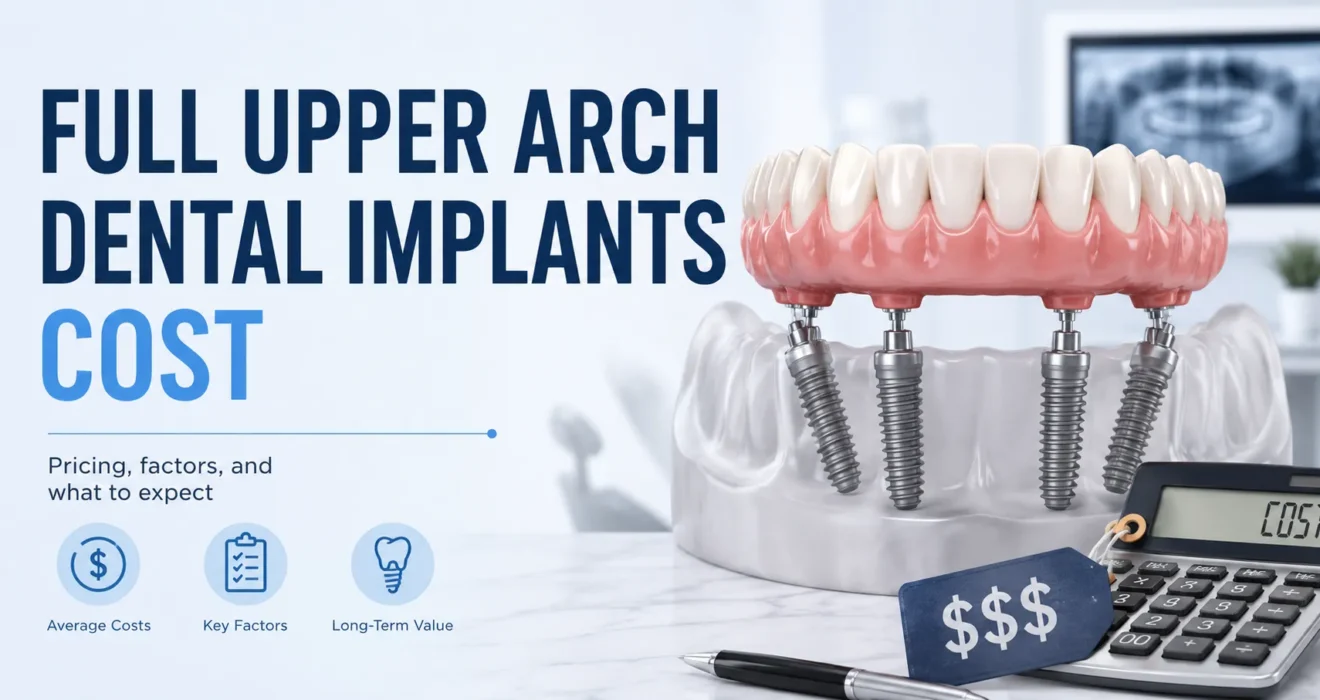
Full upper arch dental implants replace every tooth on your upper jaw using a set of implants that anchor a permanent prosthetic arch to your jawbone. Unlike traditional dentures that sit on top of your gums and can shift or slip, implant-supported arches are fixed permanently into place, functioning just like natural teeth.
There are several approaches to full arch restoration. The most popular is the All-on-4 technique, where four strategically placed implants support an entire arch of teeth. All-on-6 uses six implants for added stability, while All-on-8 offers the most robust support. There are also implant-supported dentures, which are removable but still anchor to implants, offering a more affordable middle ground.
Understanding which method suits your jaw structure, bone density, and lifestyle goals is the first step — and it directly influences the total cost of your treatment.
How Much Does a Full Upper Arch Dental Implant Cost?
This is the core question, and the answer deserves complete transparency. Below is a general cost breakdown based on widely reported industry pricing.
All-on-4 Upper Arch Dental Implants Cost
The All-on-4 is the most commonly chosen solution for full upper arch replacement. In the United States, the cost typically ranges from $20,000 to $30,000 per arch. This price generally includes the implants themselves, the abutments (connectors), the temporary prosthesis placed on the day of surgery, and the final permanent arch.
Some clinics advertise prices as low as $12,000 — but patients should approach these offers cautiously. Bargain pricing often excludes bone grafting, sedation, imaging, and the final crown, which can add thousands to your final bill.
All-on-6 and All-on-8 Implant Costs
- All-on-6: $24,000 – $35,000 per arch
- All-on-8: $28,000 – $40,000 per arch
The additional implants provide greater stability and load distribution, which can be especially important for patients with higher bite force or denser bone structure. While the upfront cost is higher, the long-term durability may justify the investment.
Implant-Supported Dentures
For patients seeking a more budget-conscious solution, implant-supported dentures (also called snap-on dentures) cost between $10,000 and $18,000 for the upper arch. These are removable but far more stable than conventional dentures, making them an excellent transitional or permanent solution for many patients.
Key Factors That Affect Full Upper Arch Dental Implants Cost
1. Geographic Location
Dental costs vary dramatically depending on where you live. Urban areas with higher overheads — such as New York, Los Angeles, or Chicago — typically charge 20–40% more than rural clinics or smaller cities. Many patients now explore dental tourism in countries like Mexico, Hungary, Turkey, or Costa Rica, where high-quality All-on-4 procedures can cost as little as $8,000 to $12,000 — though this requires careful research and choosing accredited providers.
2. Bone Grafting Requirements
One of the most significant cost additions is bone grafting. If you’ve been missing teeth for a long time, your jawbone may have deteriorated to the point where it can no longer support implants without first being rebuilt. Bone grafts can add anywhere from $500 to $3,000 per area to your overall cost, and sinus lifts — common for upper arch procedures — typically cost an additional $1,500 to $5,000.
3. Implant Material and Brand
Not all implants are created equal. Premium brands such as Nobel Biocare, Straumann, and Zimmer Biomet use medical-grade titanium with decades of clinical backing. Budget clinics may use lesser-known implant brands with shorter track records, which can affect long-term success rates. The material and brand of your implant significantly influence both the price and the longevity of your results.
4. Type of Prosthetic Used
- Acrylic prosthetics — most affordable, durable, but less natural-looking
- Porcelain or zirconia prosthetics — premium appearance, stronger, more stain-resistant, and typically $3,000–$6,000 more expensive
- Hybrid prosthetics — combine acrylic gum base with porcelain teeth for a balance of aesthetics and cost
5. Dental Surgeon’s Experience and Clinic Reputation
A highly experienced oral surgeon or prosthodontist with a strong implant success record will charge more than a general dentist offering the same procedure. This is not an area where cutting corners pays off. The expertise of your provider directly impacts the surgical precision, implant placement accuracy, and your recovery experience.
What Does the Full Upper Arch Implant Cost Include?
Understanding what’s bundled into your quote is essential. A comprehensive treatment package should include:
- Initial consultation and 3D CT scan imaging
- Extractions of any remaining teeth
- Bone grafting (if required)
- Implant placement surgery
- Sedation or anesthesia costs
- Temporary arch placed on surgery day
- Final permanent arch prosthetic
- Follow-up appointments and aftercare
Always ask for an itemized quote and clarify what’s included before signing any treatment agreement. Hidden costs are one of the most common patient complaints in the dental implant industry.
Does Insurance Cover Full Upper Arch Dental Implants?
The reality of insurance coverage for dental implants remains frustrating for most patients. Traditional dental insurance plans typically classify dental implants as a cosmetic procedure and offer little to no coverage. However, the landscape is slowly changing.
Some insurance plans will cover:
- Extractions
- Bone grafting (if medically necessary)
- Diagnostic imaging
- Anesthesia (in some surgical cases)
Medical insurance may cover portions of the procedure if tooth loss is linked to an accident, cancer treatment, or certain systemic diseases. It’s worth submitting to both your dental and medical insurance providers.
Premium dental plans, particularly those offered through Delta Dental, Cigna, or MetLife, may offer implant benefits with lifetime maximums between $1,000 and $2,000 — not enough to cover the full procedure, but a helpful contribution.
Financing Options for Full Upper Arch Dental Implants
The good news is that most reputable dental implant centers offer flexible financing to make treatment accessible. Here are your primary options:
- CareCredit — healthcare credit card offering 6–24 month interest-free promotional periods
- Lending Club Patient Solutions — personal loans designed specifically for medical and dental procedures
- In-house payment plans — many clinics offer their own installment programs, sometimes with zero interest
- Health Savings Accounts (HSA) or Flexible Spending Accounts (FSA) — pre-tax dollars can be used toward dental implants
- Personal bank loans — fixed-rate personal loans through your bank or credit union
- Dental school clinics — accredited dental schools perform implant procedures at 40–60% reduced cost under faculty supervision
FAQs
Q: What is the cheapest way to get full upper arch dental implants?
A: The most cost-effective options include dental schools (40–60% savings), dental tourism in Mexico or Eastern Europe ($8,000–$14,000), or implant-supported dentures instead of fixed arches. Always verify accreditation and surgeon credentials regardless of price.
Q: How long do full upper arch implants last?
A: With proper care, the implants themselves can last 20–30 years or a lifetime. The prosthetic arch typically needs replacement every 10–15 years due to normal wear. Good oral hygiene and regular check-ups dramatically extend longevity.
Q: Is the full upper arch dental implant procedure painful?
A: The procedure is performed under local anesthesia or IV sedation, so patients feel minimal pain during surgery. Post-operative discomfort is manageable with prescribed pain medication and typically subsides within 5–7 days.
Q: How long does the full process take from start to finish?
A: The complete process — from initial consultation to final arch placement — typically takes 3 to 9 months. The longest phase is osseointegration, where your jawbone fuses to the implants before the permanent prosthetic can be attached.
Q: Can I eat normally with full upper arch dental implants?
A: Yes — that’s one of the biggest advantages over traditional dentures. Once fully healed, patients can eat virtually any food, including hard and crunchy items that would be impossible with dentures. During the healing phase, a soft-food diet is recommended.
Q: Are full upper arch implants worth the cost?
A: For the vast majority of patients, the answer is a resounding yes. Studies consistently show that dental implant recipients report dramatically improved quality of life, including better nutrition, clearer speech, greater social confidence, and elimination of the daily hassle of removable dentures. When spread over 20+ years, the per-year cost becomes far more reasonable than it initially appears.
Conclusion
The full upper arch dental implants cost is undeniably a significant financial commitment — typically ranging from $20,000 to $40,000 depending on your chosen technique, location, materials, and individual clinical needs. But for millions of patients, it represents one of the most transformative investments they’ve ever made in their health, confidence, and overall quality of life.
The key is going in informed. Understand what drives the cost, ask the right questions, demand itemized quotes, explore financing options, and choose a provider whose experience and reputation you trust. A full arch of permanent, beautiful, functional teeth isn’t just cosmetic — it’s foundational to your wellbeing.