D4341 Dental Code Explained: SRP Billing Guide
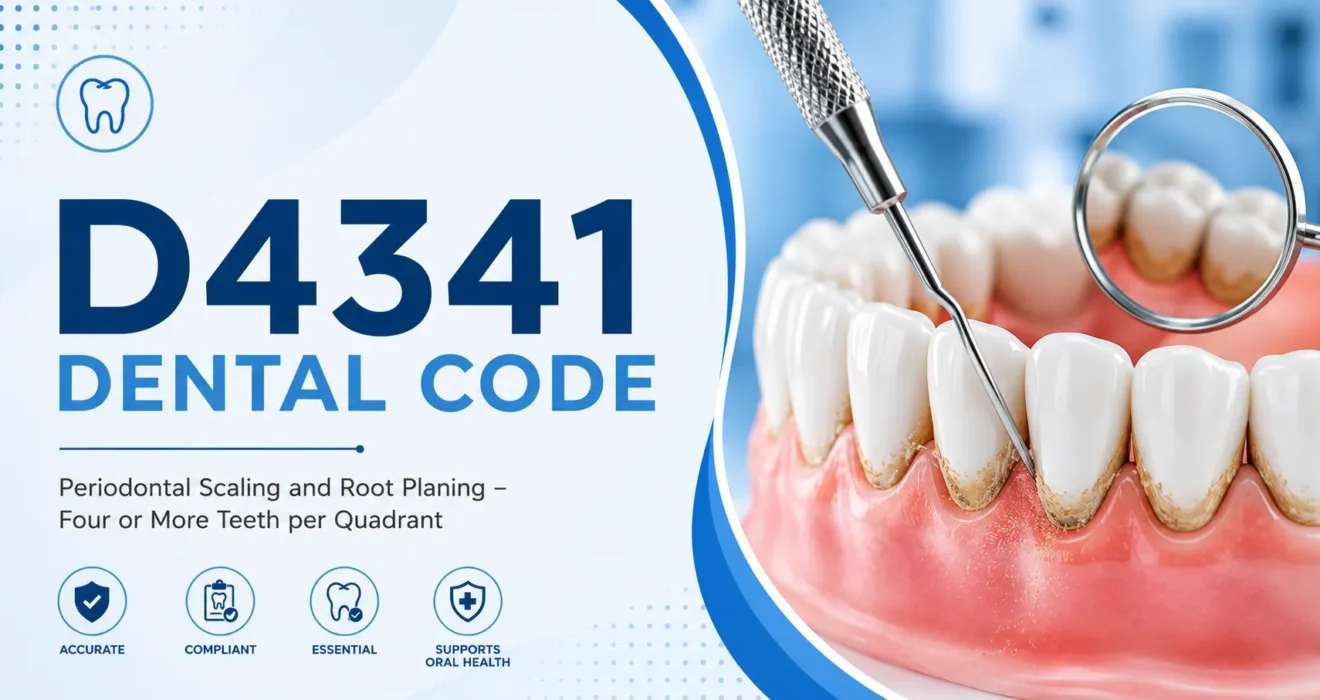
The D4341 dental code identifies a specific periodontal procedure called scaling and root planing, often shortened to SRP. Dentists use this code when they treat four or more teeth within a single quadrant of the mouth. The procedure targets patients who show clear signs of periodontal disease rather than those seeking a routine cleaning.
Scaling and root planing goes far deeper than a standard prophylaxis appointment. The dentist or hygienist instruments both the crown and the root surfaces of each affected tooth. This process removes plaque, calculus, and damaged cementum that sit below the gumline where a toothbrush cannot reach. The goal is to create a smooth root surface so the gum tissue can reattach and heal properly.
Insurance companies classify D4341 as a therapeutic procedure, not a preventive one. This distinction matters because it separates SRP from everyday cleanings covered under codes like D1110. Payers expect to see documented disease, not just routine maintenance, before they approve a D4341 claim.
The “four or more teeth” threshold is the defining feature of this code. If a quadrant only requires treatment on one to three teeth, the practice should report D4342 instead. Mixing up these two codes is one of the most frequent coding errors in periodontal billing.
Dental teams that understand D4341 correctly can document cases more accurately and reduce avoidable claim rejections. Patients also benefit when they understand why their appointment moved from a simple cleaning to a more involved periodontal procedure. Clear communication between clinical and billing staff keeps everyone aligned on what the code actually represents.
Because periodontal disease varies in severity from one patient to the next, dentists rely on careful charting to justify code selection. This sets the stage for the more detailed clinical criteria covered in the next section.
When Should You Use D4341? Clinical Signs and Diagnostic Criteria
Choosing the right code starts with the clinical exam, not the billing software. Dentists look for specific, measurable signs of periodontal disease before recommending SRP. Without this evidence, a claim is far more likely to face denial or a request for additional records.
The following findings typically support the use of D4341:
- Pocket depths of 4mm or greater, measured during a full periodontal charting session
- Bleeding on probing, which signals active gum inflammation
- Radiographic evidence of bone loss, visible on recent X-rays
- Clinical attachment loss, confirming the gum tissue has pulled away from the tooth
- At least four teeth within one quadrant that meet the above criteria
Pocket depth remains the most commonly cited benchmark, though opinions on the exact threshold vary across the dental community. Some payers accept 4mm as sufficient, while others look for deeper pocketing combined with additional symptoms. This is why checking each payer’s specific guidelines before treatment saves time later.
Here is a simple way to confirm whether a case qualifies for D4341:
- Complete a full periodontal chart for the affected quadrant.
- Identify how many teeth show qualifying pocket depths and bleeding.
- Confirm radiographs support bone loss or calculus on the root surface.
- Count the affected teeth — four or more points to D4341.
- Document the diagnosis clearly in the patient’s chart before treatment.
It’s worth noting that D4341 is not appropriate for patients with healthy gums or only mild, localized inflammation. Those cases usually fall under prophylaxis or, since 2017, the D4346 code for generalized gingival inflammation without bone loss. Matching the clinical picture to the correct code protects both the patient and the practice.
D4341 vs D4342 vs D4346: Knowing the Difference Matters
Confusing similar periodontal codes is one of the easiest ways to trigger an audit or a denied claim. Each code exists for a distinct clinical scenario, and payers expect dental teams to apply them precisely.
D4341 – Periodontal Scaling and Root Planing, Four or More Teeth Per Quadrant This code applies when the quadrant shows moderate to severe periodontitis affecting at least four teeth, supported by pocket depths, bleeding, and bone loss on radiographs.
D4342 – Periodontal Scaling and Root Planing, One to Three Teeth Per Quadrant This code is reserved for more localized periodontal involvement. The clinical criteria are similar to D4341, but the number of affected teeth is smaller.
D4346 – Scaling in the Presence of Generalized Moderate or Severe Gingival Inflammation Introduced by the ADA in 2017, this code covers full-mouth treatment for inflamed gums without evidence of bone loss. It should never be billed alongside prophylaxis or SRP for the same area.
A quick comparison helps clarify the distinctions:
| Code | Teeth Affected | Bone Loss Present? | Procedure Type |
|---|---|---|---|
| D4341 | 4 or more per quadrant | Yes | Therapeutic SRP |
| D4342 | 1–3 per quadrant | Yes | Therapeutic SRP |
| D4346 | Full mouth | No | Therapeutic scaling |
Before D4346 existed, many practices reported gingival inflammation cases under D4341 simply because no better option was available. That workaround is no longer acceptable, and payers now scrutinize claims more closely to confirm bone loss is genuinely present before approving D4341 or D4342.
Documentation Checklist: What Insurers Want to See for D4341 Claims
Strong documentation is the single biggest factor separating an approved D4341 claim from a denied one. Insurers want proof that the procedure matches the diagnosis, not just a code on a claim form.
A complete D4341 claim package generally includes:
- Full periodontal charting showing pocket depths, bleeding points, and recession for every tooth in the treated quadrant.
- Current radiographs that clearly demonstrate bone loss or heavy calculus on root surfaces.
- A detailed clinical narrative explaining why SRP was necessary, referencing specific tooth numbers and measurements.
- The treatment plan, connecting the diagnosis to the recommended procedure.
- Patient history, including prior cleanings or periodontal treatment that did not resolve the disease.
When writing the clinical narrative, specificity makes all the difference. A vague note saying “patient needs deep cleaning” rarely satisfies a reviewer. A stronger narrative might describe exact pocket depths and bleeding sites on named teeth within the treated quadrant.
It also helps to record the exact number of teeth treated in each quadrant. Since the line between D4341 and D4342 depends entirely on that count, leaving it out invites unnecessary scrutiny. Practices that build this habit into their charting workflow tend to see fewer requests for additional information from payers.
D4341 Insurance Coverage, Frequency Limits, and Reimbursement Tips
Coverage for D4341 varies significantly depending on the patient’s specific dental plan. Most insurers reimburse this procedure once every 24 to 36 months per quadrant, though exact frequency limits differ by payer and sometimes by plan within the same payer. Verifying benefits before treatment helps avoid an unexpected bill for the patient.
A few practical reimbursement tips can improve approval rates:
- Always confirm the patient’s benefit details before scheduling SRP, especially frequency limitations.
- Submit complete documentation with the first claim rather than waiting for a denial to add records.
- Reference the Explanation of Benefits (EOB) carefully if a claim is denied, since the stated reason often points to a missing piece of documentation.
- File a well-supported appeal when a denial seems inconsistent with the clinical evidence.
- Track outstanding D4341 claims in accounts receivable and follow up consistently rather than letting them age.
Billing more than two quadrants of SRP in a single visit often triggers an automatic request for additional records. Some plans, including certain Medicaid programs, even limit how many quadrants can be billed on the same date of service. Spacing treatment across separate appointments, when clinically appropriate, can reduce friction during claims processing.
Common D4341 Billing Mistakes (and How to Avoid Costly Denials)
Even experienced dental teams occasionally make errors when billing D4341. Recognizing these common pitfalls makes it much easier to avoid them.
- Miscounting affected teeth — billing D4341 when only one to three teeth in the quadrant truly meet the criteria, which should instead be reported as D4342.
- Insufficient documentation — submitting a claim without periodontal charting or radiographs to support the diagnosis.
- Confusing D4341 with D4346 — applying the SRP code to a case of generalized inflammation that has no bone loss.
- Overlooking frequency limits — rebilling SRP for the same quadrant before the payer’s allowed time period has passed.
- Billing too many quadrants at once — submitting more than two quadrants in a single visit without the extra documentation payers typically require.
Practices that audit their own SRP claims periodically tend to catch these issues before they become a pattern. Training clinical and front-office staff together on the difference between D4341, D4342, and D4346 also reduces confusion at the point of care. A small investment in coding accuracy pays off through fewer denials and faster reimbursement.
Conclusion
The D4341 dental code plays a central role in treating moderate to severe periodontal disease, but using it correctly takes more than memorizing a number. Dentists need solid clinical evidence — qualifying pocket depths, bleeding, and bone loss — across four or more teeth in a single quadrant. Billing teams need thorough documentation that connects the diagnosis to the procedure performed.
Understanding how D4341 differs from D4342 and D4346 prevents many of the denials practices see today. Pairing that knowledge with detailed periodontal charting, clear clinical narratives, and proactive benefit verification gives every claim its best chance of approval. With these habits in place, dental practices can focus more on patient care and less on chasing unpaid claims.