D4910 Dental Code: Your Guide to Periodontal Maintenance
Patients often see the D4910 dental code on a billing statement and have no idea what it means. This code refers to periodontal maintenance, a specialized cleaning that follows active gum disease treatment. It is not the same as a routine dental cleaning, and insurance companies treat it differently too. Understanding this code helps you avoid billing surprises and stay on top of your gum health. This guide breaks down everything you need to know about D4910, from eligibility rules to insurance coverage, in plain and simple language.
What Is the D4910 Dental Code? A Simple Breakdown of Periodontal Maintenance
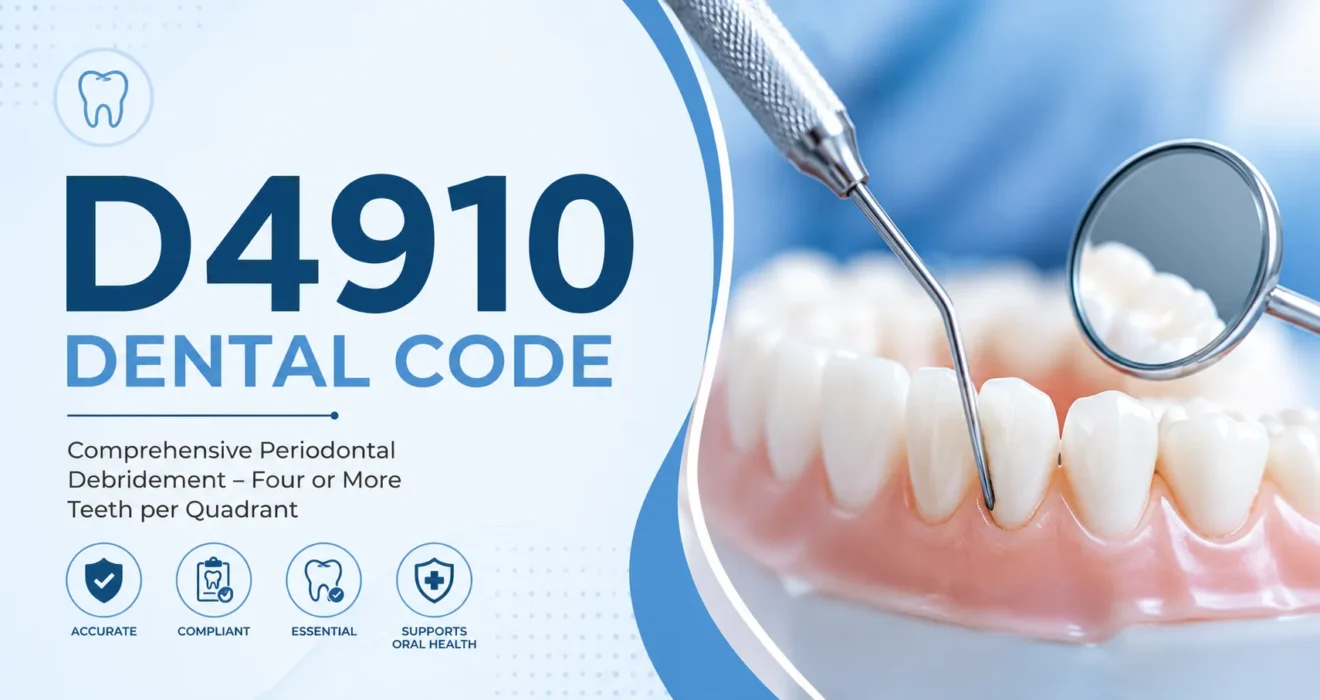
D4910 is the dental billing code dentists use for periodontal maintenance therapy. It applies to patients who have already completed active treatment for periodontal disease, such as scaling and root planing or periodontal surgery. The American Dental Association created this code to separate maintenance care from a standard prophylaxis cleaning, since the two procedures address very different needs.
Periodontal maintenance focuses on controlling gum disease that has already affected the supporting structures of the teeth. Once a patient finishes active treatment, the disease does not simply disappear. Bacteria can return below the gumline, and pockets around the teeth remain more vulnerable than healthy gum tissue. D4910 exists to manage this ongoing risk through regular, targeted care.
Dentists and hygienists use this code because the procedure itself differs from a basic cleaning. It includes deeper instrumentation, site-specific scaling, and closer monitoring of pocket depths. The work happens both above and below the gumline, targeting areas that are prone to bacterial buildup after periodontal treatment.
Insurance companies also distinguish D4910 from D1110, the code for a regular adult cleaning. This distinction matters because coverage rules, frequency limits, and patient costs often differ between the two. Many patients are surprised to learn their insurance treats periodontal maintenance as a separate benefit category altogether.
The American Academy of Periodontology recognizes periodontal maintenance as a lifelong commitment for patients who have experienced gum disease. Skipping these visits raises the risk of disease returning, which can ultimately lead to tooth loss. This is why dentists rarely classify D4910 as optional once a patient needs it.
Knowing this code helps patients ask better questions at the front desk and understand exactly why their dentist recommends more frequent visits. It also helps clarify why the cost and coverage may look different from a typical six-month cleaning appointment.
When Do Dentists Use D4910? Eligibility Rules and Treatment Timing
Who Qualifies for Periodontal Maintenance Care?
Not every patient qualifies for the D4910 code. Dentists reserve it for individuals with a documented history of periodontal disease and prior active treatment. Here is what typically determines eligibility:
- The patient has completed scaling and root planing (D4341/D4342) or periodontal surgery
- The patient shows measurable periodontal pocket depths beyond healthy ranges
- A periodontist or general dentist has formally diagnosed periodontal disease
- The patient’s records show ongoing risk factors, such as bone loss or bleeding gums
- The dentist determines that standard prophylaxis is no longer sufficient for the patient’s gum health
Most dental practices schedule periodontal maintenance every three to four months instead of the standard six-month interval. This shorter cycle helps prevent bacteria from re-establishing themselves in periodontal pockets. The exact frequency depends on individual risk and how the patient’s gums respond to treatment over time.
Patients sometimes move between D1110 and D4910 depending on their gum health. If periodontal disease returns after a period of stability, a dentist may switch the patient back to maintenance care. This flexibility allows treatment to match the current state of a patient’s oral health rather than locking them into one category permanently.
What Happens During a D4910 Visit? The Procedure Explained Step by Step
The D4910 Appointment Process
A periodontal maintenance visit looks similar to a regular cleaning on the surface, but the steps underneath are more detailed and clinical. Here is what typically happens during the appointment:
- The hygienist reviews the patient’s periodontal chart and prior pocket depth measurements.
- They remeasure pocket depths around each tooth to track changes since the last visit.
- Supragingival and subgingival plaque and calculus are removed using specialized instruments.
- Root surfaces are smoothed in areas with previous attachment loss to discourage bacterial regrowth.
- The dentist or hygienist checks for bleeding, inflammation, or signs of active infection.
- Polishing is performed, followed by patient education on home care techniques.
- The dentist reviews findings and confirms the next maintenance interval based on the results.
This process takes longer than a standard cleaning because it requires more precise instrumentation and closer monitoring. Many practices also use this visit to evaluate whether additional periodontal therapy is needed if pocket depths have worsened.
D4910 vs D1110: Why Periodontal Maintenance Is Not a Regular Cleaning
Key Differences Patients Should Understand
Patients often ask why periodontal maintenance costs more or happens more often than a regular cleaning. The answer lies in how different these two procedures actually are.
A standard cleaning (D1110) addresses plaque and tartar on healthy gum tissue with no history of periodontal disease. It typically happens twice a year and focuses on prevention rather than active disease management.
Periodontal maintenance (D4910), on the other hand, treats gums that have already experienced bone or attachment loss. It requires deeper instrumentation, more frequent visits, and ongoing clinical evaluation of pocket depths.
The billing codes themselves reflect this clinical difference, which is why insurance plans rarely treat them as interchangeable benefits. Some insurers apply periodontal maintenance toward a separate annual maximum or limit the number of covered visits per year.
Patients with a periodontal disease history cannot simply request a switch back to D1110 cleanings. The clinical need drives the code selection, not patient preference or cost concerns. Dentists must document the ongoing condition to justify continued use of D4910.
Does Insurance Cover D4910? Billing Tips Every Patient Should Know
Insurance and Billing Considerations
Insurance coverage for the D4910 dental code varies widely between plans, and patients should never assume it works exactly like a routine cleaning benefit. Many plans cover periodontal maintenance at a lower percentage than preventive cleanings, sometimes treating it as a basic or major service instead.
Frequency limits also differ significantly from one insurer to another. Some plans cover up to four periodontal maintenance visits per year, while others cap coverage at fewer visits or apply waiting periods after active treatment ends.
Patients should always request a pre-treatment estimate before their first D4910 appointment. This step clarifies exactly how much the insurance plan will pay and what portion the patient owes out of pocket.
Dental offices typically submit periodontal charting and treatment history alongside the claim. This documentation proves medical necessity and reduces the chance of a denied claim. Without proper records, insurers may question whether the patient truly needs maintenance care instead of a standard cleaning.
Out-of-network coverage tends to be less predictable for this code. Patients with PPO plans should verify benefits directly with their insurer rather than relying solely on the dental office’s estimate, since plan details can change yearly.
Final Thoughts on the D4910 Dental Code
The D4910 dental code represents far more than a billing detail buried in paperwork. It reflects a structured, ongoing approach to managing periodontal disease after active treatment ends. Patients who understand this code can better anticipate costs, ask informed questions, and stay committed to the maintenance schedule their dentist recommends.
Skipping periodontal maintenance visits puts long-term oral health at risk, since gum disease rarely stays fully controlled without consistent care. Regular D4910 appointments help catch problems early, before they progress into more serious and costly issues. Patients should view this code as part of a long-term strategy for protecting their teeth and gums, not as an inconvenience or an unnecessary expense.
If you have questions about whether D4910 applies to your treatment plan, talk directly with your dental office. They can review your periodontal history, explain your insurance benefits, and help you understand exactly why this code appears on your bill.