D4346 Dental Code Explained: Billing & Coverage Guide
If you have ever looked at a dental claim and wondered what the code “D4346” actually means, you are not alone. This single code causes more confusion in dental offices than almost any other entry in the CDT code set. Patients see it on an invoice and assume it is a routine cleaning. Insurance companies sometimes deny it outright. Even experienced front-desk teams occasionally mix it up with scaling and root planing. This guide breaks down exactly what the D4346 dental code means, when a dentist should use it, how it differs from other cleaning codes, and how your practice can document and bill it correctly so claims get paid the first time.
What Is the D4346 Dental Code? A Plain-English Breakdown
The American Dental Association introduced D4346 in 2017 to close a gap in the CDT code set. Before this code existed, dentists had only two options for a full-mouth cleaning: a routine prophylaxis or a full periodontal scaling and root planing procedure. Neither fit patients with more inflammation than a healthy mouth but not enough bone loss for periodontal treatment.
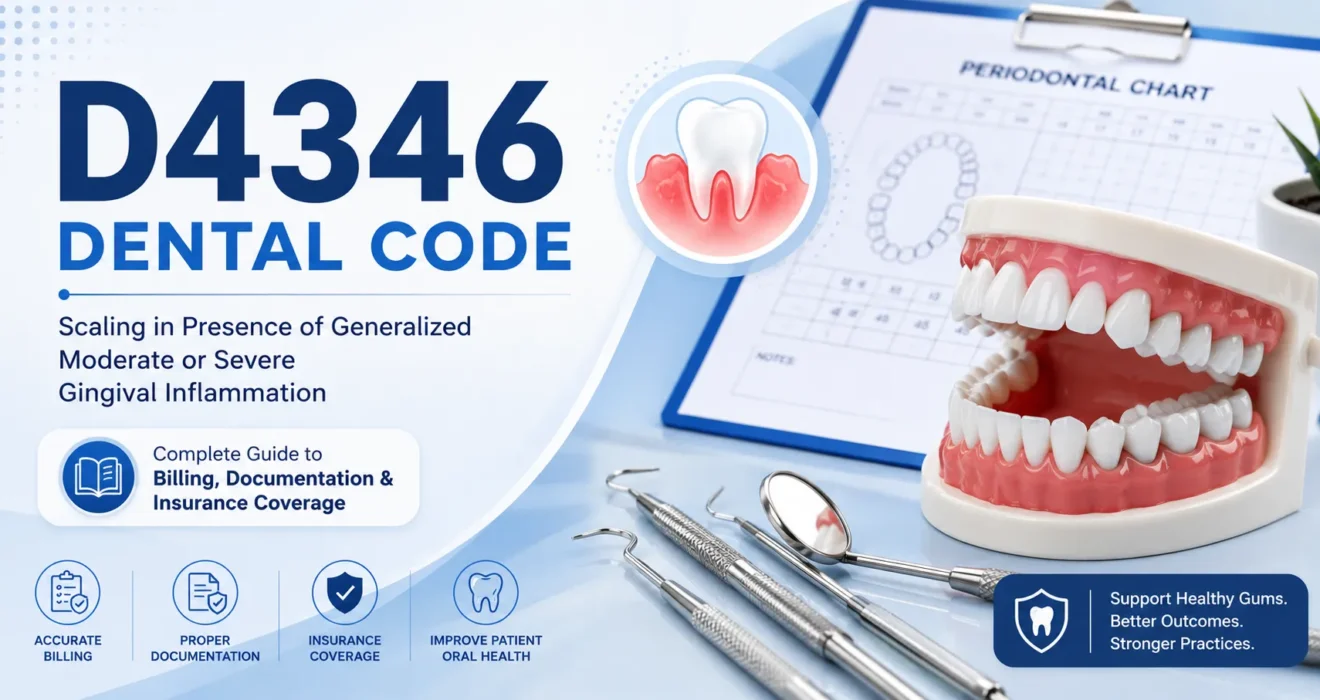
The official descriptor reads as scaling performed in the presence of generalized moderate or severe gingival inflammation across the full mouth, completed after an oral evaluation. In simpler terms, it describes a therapeutic cleaning for patients whose gums are swollen and bleeding throughout most of the mouth, even though bone and attachment remain intact.
During the procedure, the hygienist or dentist removes plaque, calculus, and surface stains from above and below the gumline. The goal is not cosmetic. It reduces inflammation and restores gum health before the patient resumes a normal preventive schedule, making D4346 a therapeutic rather than a preventive procedure.
Dentists reach for this code when a patient shows generalized bleeding on probing, puffy or red gum tissue, and heavier plaque than a routine visit would explain. These signs need to appear broadly across the mouth, since one isolated inflamed spot usually does not justify this code alone.
D4346 is not tied to a specific age group. It applies to adults, teenagers, and children, including orthodontic patients who accumulate extra plaque around brackets and wires. What matters clinically is the generalized inflammation, not the patient’s age.
Because this code sits between prevention and periodontal therapy, the diagnosis and paperwork have to match. A vague chart note or a missing periodontal evaluation often separates a clean reimbursement from a denial.
When Should You Use D4346? Key Clinical Criteria Dentists Rely On
Choosing the right code starts with the clinical picture in front of you. D4346 is not meant to replace judgment, but the ADA has outlined fairly specific indicators that support its use.
Signs That Point Toward D4346
Most dental teams look for a combination of the following findings before selecting this code:
- Generalized moderate to severe gingival inflammation, rather than a few isolated spots
- Widespread bleeding on probing during the periodontal exam
- Supragingival and subgingival calculus and plaque beyond what a routine cleaning would address
- Suprabony pockets without evidence of attachment or bone loss
- Involvement across roughly 30 percent or more of the dentition
What D4346 Specifically Rules Out
Just as important as knowing when to use this code is knowing when not to. D4346 does not apply when:
- The patient already shows radiographic or clinical evidence of periodontitis, which would point toward scaling and root planing instead.
- The inflammation is localized to one or two teeth rather than spread across the mouth.
- The visit is simply a longer or more difficult version of a standard cleaning, sometimes informally called a “hard prophy.” Extra chair time alone does not justify this code.
- The patient has no natural teeth and only needs maintenance of implant-supported prosthetics, since a different code applies there.
A periodontal chart and, in many cases, supporting radiographs should back up the decision either way. Insurance reviewers will often ask for this documentation directly, so having it ready in the patient’s file from the start saves time later.
D4346 vs. D1110 and D4341/D4342: What’s the Real Difference?
Understanding D4346 becomes much easier once you see it next to the codes on either side of it. Dental teams frequently describe it as the bridge between a routine cleaning and a periodontal procedure, and that description holds up well in practice.
D1110 (Adult Prophylaxis) is the standard preventive cleaning for patients with a healthy or only mildly inflamed periodontium. It is quick, preventive, and does not require the kind of inflammation documentation that D4346 demands.
D4346 (Full-Mouth Scaling with Inflammation) sits in the middle. It applies when inflammation is widespread and more severe than a prophy patient, but the bone and attachment levels remain healthy. Think of it as treating gum disease before it becomes periodontal disease.
D4341/D4342 (Scaling and Root Planing) is reserved for patients who already show bone or attachment loss, confirmed through periodontal charting and radiographs. This procedure targets root surfaces below the gumline and is billed per quadrant rather than for the full mouth.
A simple way to remember the order: prevention, then inflammation management, then periodontal therapy. Each code represents a different stage of gum health, and billing the wrong one is one of the most common reasons claims get flagged for review.
It is also worth noting that D4346 cannot be billed alongside a prophylaxis, scaling and root planing, or debridement procedure on the same date of service. The one notable exception involves a separate code used specifically for scaling around a single dental implant, which follows its own set of rules.
How to Document and Bill D4346 Without Triggering Denials
Clean documentation is the single biggest factor separating a paid D4346 claim from a denied one. Insurance carriers vary in their exact requirements, but a few practices apply almost universally.
Steps for Accurate D4346 Claims
- Complete a full periodontal evaluation before the procedure, including probing depths and bleeding points across the mouth, not just a few teeth.
- Capture supporting radiographs that confirm the absence of bone loss, since this distinguishes D4346 from scaling and root planing.
- Write a clear clinical narrative describing the generalized nature of the inflammation, the percentage of the mouth affected, and the specific findings that led to this diagnosis rather than a routine cleaning.
- Avoid combining codes on the same visit, since pairing D4346 with a prophylaxis or SRP code on one claim almost guarantees a denial or a request for clarification.
- Submit perio charting alongside the claim whenever the payer allows attachments, since reviewers often deny claims simply because the supporting data was missing, not because the treatment was inappropriate.
- Train front-desk and billing staff to recognize the difference between this code and a “deep cleaning,” since miscommunication at checkout creates confusion and patient complaints later.
Many practices that struggle with repeated denials eventually realize the issue is not the treatment itself but inconsistent charting across providers. Standardizing how hygienists and dentists document generalized inflammation, pocket depths, and bleeding points makes a noticeable difference in approval rates over time.
Does Insurance Cover D4346? Coverage, Costs, and Patient Communication
Coverage for D4346 varies considerably from one dental benefit plan to another. Because the ADA’s code descriptor does not set a specific reimbursement amount or frequency, each insurance company decides independently how often it will pay for this procedure and under what conditions.
Several factors typically influence whether a claim gets approved:
- The specific plan’s definition of periodontal versus preventive services, since some payers classify D4346 differently
- Frequency limitations, which may restrict how often the procedure can be billed within a benefit year
- The strength of supporting documentation submitted with the claim
- Whether the patient’s plan requires pre-authorization for procedures that fall outside routine cleanings
Patients are often surprised when D4346 is billed differently than a standard cleaning, sometimes with a different co-insurance percentage or a separate deductible category. This is where clear communication matters. Before the procedure, it helps to explain in plain language why the treatment differs from a routine cleaning, what the gum tissue shows, and how the recommended care plan supports long-term oral health.
It is also worth telling patients that there is no fixed waiting period before they can return to a normal preventive cleaning schedule after D4346. The dentist determines that timeline based on how well the gum tissue responds to treatment, not a rigid calendar rule. Setting these expectations upfront reduces billing confusion and builds trust, especially for patients who are budget-conscious or skeptical of unfamiliar charges.
Conclusion: Getting D4346 Right for Better Care and Cleaner Claims
The D4346 dental code exists for a real and common clinical situation: patients with widespread gum inflammation who need more than a standard cleaning but do not yet require periodontal therapy. Used correctly, it protects the accuracy of a patient’s diagnosis, supports better long-term gum health, and keeps insurance claims moving smoothly through the system.
Getting it right comes down to two things. First, the clinical picture has to genuinely match the code, meaning generalized inflammation without bone or attachment loss. Second, the documentation has to back up that picture with periodontal charting, radiographs, and a clear narrative. When both pieces line up, dental teams see fewer denials, patients understand their treatment and their bill, and the practice spends less time chasing reimbursements that should have been straightforward in the first place.
Whether you are a dentist refining your diagnostic process, a hygienist learning the clinical thresholds, or a billing coordinator trying to reduce denial rates, understanding D4346 thoroughly pays off in fewer rejected claims and more confident patient conversations.