D6058 Dental Code Explained: Guide to Abutment-Supported Crowns
Dental billing teams handle dozens of codes every week, and implant-related codes cause the most confusion. The D6058 dental code sits right in the middle of that confusion because it looks similar to several neighboring codes. This guide breaks down exactly what D6058 means, when your practice should use it, and how to avoid the documentation mistakes that lead to denied claims. You will also learn how this code compares to D6057, D6059, and D6065, since payers frequently reject claims when teams mix these up. By the end of this article, you will code implant crown procedures with confidence and submit cleaner claims.
What Does the D6058 Dental Code Actually Cover?
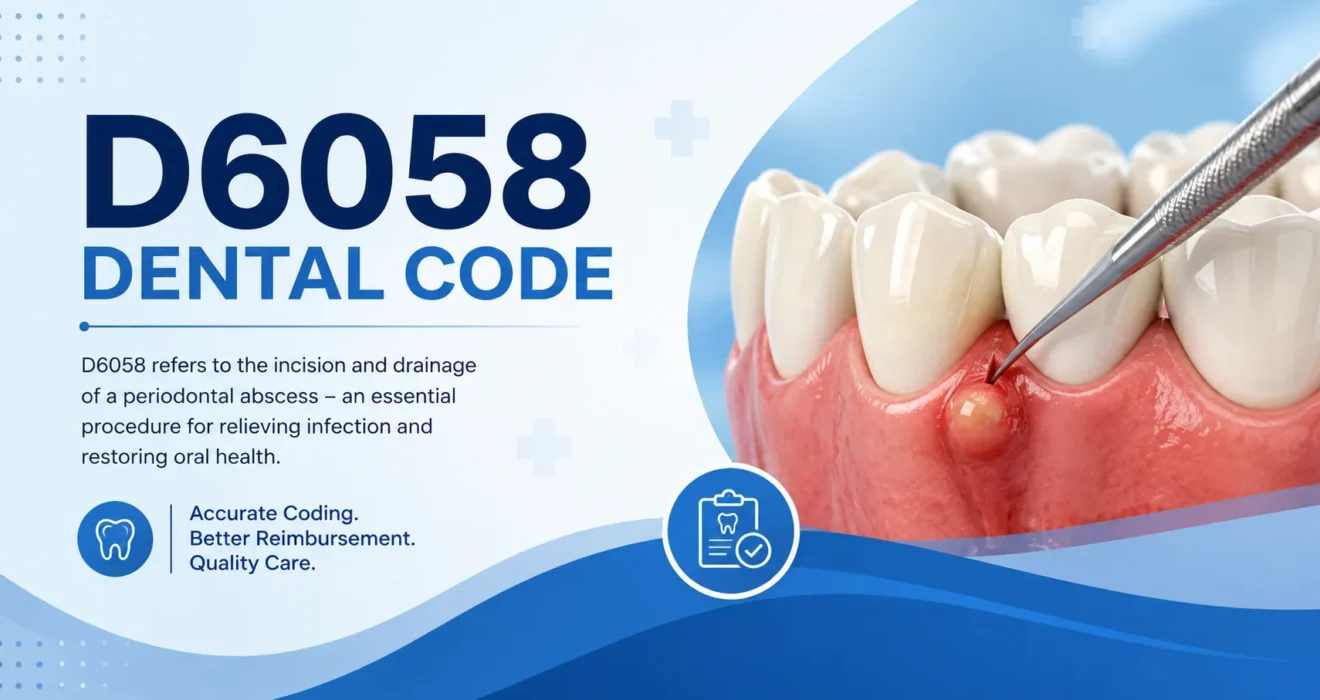
The D6058 dental code describes an abutment-supported porcelain or ceramic crown. This code falls under the Prosthodontics (Fixed) category within the Implant Services section of the Current Dental Terminology system maintained by the American Dental Association. Dentists report this code when a patient receives a single crown that rests on an implant abutment rather than directly on the implant body itself or on a natural tooth.
The crown itself must be made entirely from porcelain or ceramic material with no metal substructure. This detail matters because many patients choose all-ceramic restorations for cosmetic reasons, and the material composition directly determines which code applies. Practices that restore anterior teeth often lean toward this code since metal-free crowns blend naturally with surrounding teeth.
An abutment must already be in place before this code applies, and that abutment can be either prefabricated or custom fabricated. The abutment itself gets billed separately under D6056 for prefabricated components or D6057 for custom fabricated components. D6058 only covers the crown that sits on top of that abutment, not the abutment hardware underneath it.
This distinction trips up many billing teams who assume one code should cover the entire implant restoration. In reality, implant crown billing almost always requires two separate codes working together. The abutment code addresses the foundation piece, while D6058 addresses the visible crown restoration that patients see and chew with every day.
Insurance carriers pay close attention to this code because implant restorations carry higher costs than traditional crowns. Many dental plans include waiting periods, missing tooth clauses, or frequency limitations that specifically target implant-related procedures. Understanding the exact scope of D6058 helps your front desk team set accurate patient expectations before treatment even begins.
Clinical documentation plays a massive role in whether D6058 claims get approved on the first submission. Payers want clear evidence that the crown is cemented to an abutment rather than screwed directly into the implant body, since that distinction separates D6058 from its closest coding relative, D6065.
When Should Your Practice Use the D6058 Dental Code?
Selecting the right moment to apply D6058 requires understanding both the clinical scenario and the material used. Dental teams should only assign this code when every condition below applies to the actual treatment delivered.
Use D6058 when the following clinical situation occurs:
- The patient has an osseointegrated implant already placed and healed
- A prefabricated or custom abutment has been seated and torqued onto that implant
- A single crown made entirely from porcelain or ceramic is cemented onto the abutment
- The crown retention comes from cement, not from a screw passing through the crown into the implant body
- The restoration replaces one tooth rather than a full arch or bridge span
This code becomes the preferred option in several real-world clinical scenarios:
- Patients with documented metal allergies or sensitivities who cannot tolerate alloy-based crowns
- Anterior esthetic cases where translucent, metal-free materials produce a more natural appearance
- Patients seeking biocompatible, all-ceramic restorations for personal preference reasons
- Cases where the treatment plan already calls for a separate abutment placement step
It helps to think about the restoration as two distinct building blocks stacked on top of each other. The implant body sits in the bone, the abutment connects to that implant body, and the crown sits on top of the abutment. Each piece in that stack gets its own code, and D6058 only describes the top piece.
Practices should also verify the crown’s material composition before submitting a claim. Some labs now produce 3D-printed crowns, and these can qualify as porcelain or ceramic restorations only if the material contains more than fifty percent inorganic filler content. Confirming this detail with your lab prevents a coding error that could trigger an audit later.
How D6058 Compares to Similar Implant Crown Codes
Dental coding errors often happen because several implant crown codes sound nearly identical on paper. Reviewing these side-by-side comparisons will sharpen your team’s ability to select the correct code every time.
D6058 vs. D6065: Abutment-Supported or Implant-Supported?
This comparison causes the most claim denials across general dentistry and prosthodontic practices nationwide.
| Feature | D6058 | D6065 |
|---|---|---|
| Crown retention | Cemented to an abutment | Screw-retained through the crown |
| Abutment billed separately | Yes (D6056 or D6057) | No, abutment is integrated |
| Material | Porcelain or ceramic | Porcelain or ceramic |
| Common error | Billed when crown is actually screw-retained | Billed when an abutment was placed separately |
The simplest rule to remember: if cement holds the crown onto a separate abutment, code it as D6058. If a screw passes through the crown directly into the implant body with no cement layer, code it as D6065 instead.
D6058 vs. D6057: Crown or Abutment?
D6057 describes the custom fabricated abutment itself, while D6058 describes the porcelain crown that sits on that abutment. These two codes almost always appear together on the same claim for custom abutment cases, since one cannot exist clinically without the other in this treatment sequence.
D6058 vs. D6059: Material Matters Most
D6059 applies when the crown contains porcelain fused to high noble metal rather than an all-ceramic composition. Always confirm the exact material listed on the laboratory prescription before choosing between these two codes, since billing the wrong material classification ranks among the most common implant coding mistakes nationwide.
Documentation Requirements That Protect Your D6058 Claims
Strong documentation transforms a vulnerable claim into an approved one. Insurance auditors specifically look for evidence connecting the diagnosis to the procedure code submitted, so your clinical notes need to tell a complete story.
Your chart notes should include these essential elements:
- A clearly recorded patient chief complaint and relevant dental history
- Clinical findings that specifically justify an abutment-supported crown rather than another restoration type
- Diagnostic imaging or supplementary records supporting implant integration and abutment placement
- A written treatment plan that connects the diagnosis directly to the D6058 procedure
- Post-procedure notes covering outcomes, occlusion checks, and follow-up recommendations
Front office teams should also confirm insurance benefits before treatment begins rather than after the crown gets delivered. Implant crowns frequently carry plan-specific limitations, including waiting periods of several months or missing tooth clauses that exclude coverage entirely. Filing a pre-determination request alongside supporting x-rays significantly reduces the risk of an unexpected denial reaching the patient’s bill.
Claims should also state plainly that the crown is abutment-supported and constructed from porcelain or ceramic material. Vague claim language forces reviewers to guess, and guessing usually favors denial rather than approval.
Common Billing Mistakes Practices Make With D6058
Even experienced billing teams slip up on implant crown coding from time to time. Recognizing these patterns helps your practice catch errors before submission rather than after a denial letter arrives.
- Reporting only one code when the treatment actually requires both an abutment code and the D6058 crown code together
- Selecting D6065 by habit even when documentation clearly shows a cemented, abutment-supported crown
- Listing the wrong material classification on the claim form when the lab prescription specifies a different composition
- Skipping the tooth number field that identifies exactly which implant position is being restored
- Failing to request a pre-determination before treatment when the patient’s plan has known implant limitations
Reviewing every implant claim against the lab slip and the clinical chart before submission catches most of these errors immediately. A short internal checklist can save your practice significant time spent on appeals and resubmissions later.
Insurance Coverage and Reimbursement Considerations
Reimbursement for D6058 varies considerably between insurance carriers, and even identical claims submitted by two different practices can receive different payment amounts. Several factors influence this outcome beyond the code itself.
Plan-specific waiting periods often delay coverage for new implant patients, sometimes requiring twelve months of continuous enrollment before benefits apply. Many plans also enforce a replacement limitation, commonly five to ten years, before they will pay for a second restoration on the same implant.
When a patient’s plan excludes implant crown coverage entirely, practices should request an alternate benefit for a similar crown type instead of accepting an automatic denial. Providing the patient with clear financial consent forms and discussing payment plan options keeps the conversation transparent and avoids billing surprises after treatment.
Negotiating participation status with major PPO networks can also influence reimbursement rates over time. Practices that regularly review their fee schedules against current PPO contracts often discover opportunities to improve revenue on commonly billed implant codes like D6058.
Conclusion
The D6058 dental code describes a specific, well-defined procedure: a porcelain or ceramic crown cemented onto an implant abutment. Getting this code right depends on confirming the crown’s retention method, verifying the material composition, and pairing it correctly with the appropriate abutment code. Strong clinical documentation and proactive insurance verification protect your practice from denials and keep claims moving smoothly through the payer’s review process. Mastering the small distinctions between D6058, D6057, D6059, and D6065 will save your billing team time, reduce appeals, and help your practice get paid accurately for the implant restorations you deliver every day.