D1110 Dental Code: The Complete Adult Prophylaxis Guide
Anyone who handles dental insurance claims has typed the d1110 dental code into a claim form at some point. It looks simple on the surface. Yet insurance companies still reject D1110 claims over small documentation gaps. Patients get confused when their “regular cleaning” appears under unfamiliar terminology on a bill. Front desk teams scramble to explain CDT codes during a busy day.
This guide breaks down everything you need to know about the d1110 dental code. You will learn exactly what the code covers and who qualifies for it. You will see how it differs from similar codes like D1120 and D4910. You will also pick up practical billing tips that reduce denials and speed up reimbursement. By the end, coding D1110 correctly will feel like routine practice instead of guesswork.
What Is the D1110 Dental Code? A Plain-English Breakdown
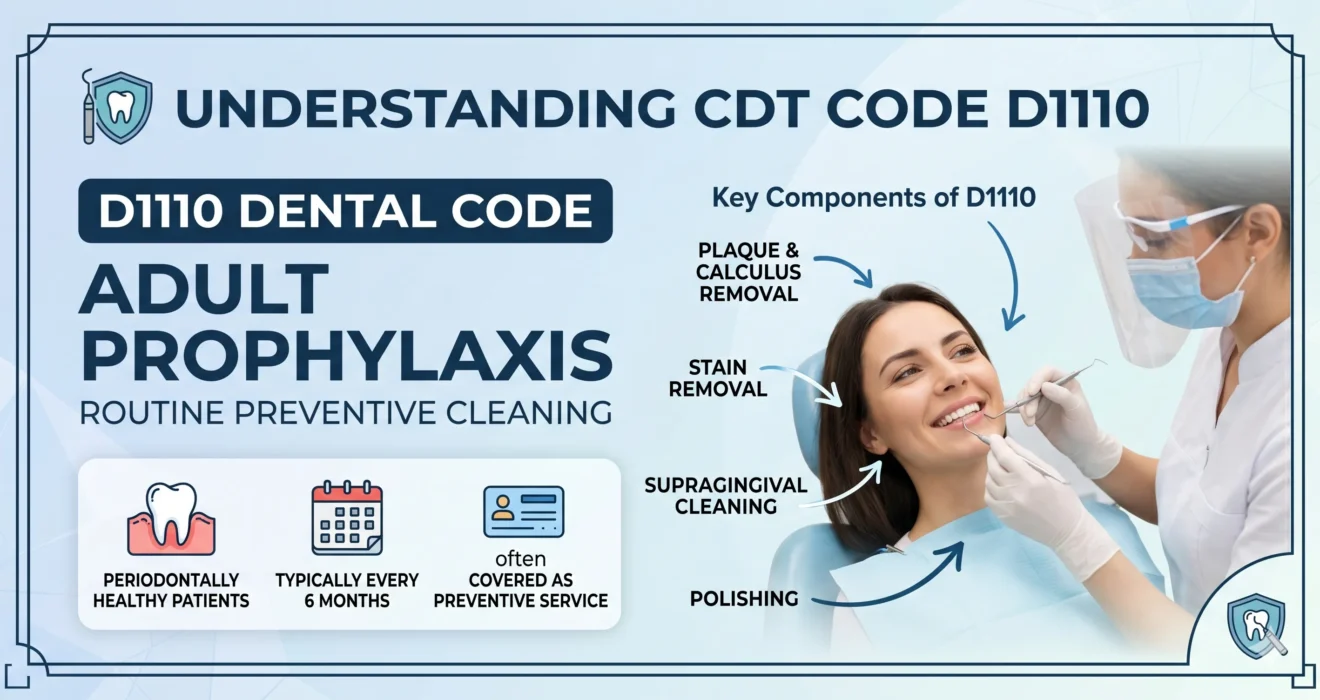
The d1110 dental code is the CDT code the American Dental Association assigns to adult prophylaxis, the formal name for a routine dental cleaning. Dentists and hygienists use this code to bill for removing plaque, calculus, and surface stains from the teeth. It sits inside the Preventive category of the CDT code set, specifically within the prophylaxis section. Most patients simply know this visit as their six-month cleaning.
D1110 applies to patients with permanent or transitional dentition, which usually means anyone around age thirteen or older. The defining factor is the patient’s tooth development, not a strict birthday. A teenager with a full set of adult teeth qualifies for D1110, while an adult who still has retained baby teeth might not. This distinction matters because some insurance plans layer their own age rules on top of the clinical definition.
During a D1110 visit, the hygienist removes soft and hardened deposits from above and slightly below the gumline. The goal is to control local irritants before they cause inflammation or bone loss. Polishing typically follows scaling to smooth the tooth surface and lift surface stains. The entire procedure stays preventive, meaning it targets a mouth that is healthy or only mildly inflamed.
Choosing D1110 correctly protects both the patient’s wallet and the practice’s revenue. Preventive codes like D1110 usually receive a high reimbursement percentage, sometimes one hundred percent, under most dental plans. Billing the wrong code can shift the visit into a different benefit category with lower coverage. That single coding decision can change what a patient owes out of pocket at checkout.
Most benefit plans cover D1110 twice within a calendar year, though some allow three visits depending on the plan design. Frequency limitations reset on different schedules depending on the insurer, so verifying benefits before scheduling saves everyone a headache later. Patients who switch dental offices mid-year sometimes hit a frequency limit without realizing it. A quick eligibility check prevents an unwelcome surprise at the front desk.
None of this works without solid documentation behind the code. Clinical notes, periodontal charting, and any relevant radiographs should support the choice of D1110 over a similar code. Insurers increasingly request this evidence before approving payment on a claim. The next sections walk through exactly when to use D1110 and how to avoid the paperwork mistakes that trigger denials.
When Should Your Dental Office Use D1110?
Not every cleaning qualifies for this code, so it helps to picture the scenarios where it clearly applies, and then walk through a quick confirmation process before billing.
Typical Patient Scenarios for D1110
- A patient comes in for a routine six-month cleaning with no history of gum disease.
- An adult patient shows mild, localized gingivitis but no measurable bone loss.
- A patient with implant-supported crowns needs plaque removed from natural teeth and implant surfaces.
- A new patient transfers records showing a healthy periodontal history and requests a standard cleaning.
- A teenager with fully erupted adult teeth visits for their first “grown-up” cleaning.
Step-by-Step: Confirming D1110 Is the Right Code
- Review the patient’s periodontal charting for pocket depths and bleeding points.
- Confirm there is no history of scaling and root planing or periodontal surgery.
- Check whether the patient has permanent or transitional dentition, not just their age.
- Verify the insurance plan’s frequency limit and any age-based edits.
- Document the clinical findings that justify a preventive, rather than therapeutic, level of care.
D1110 vs. Other Prophylaxis Codes: Spotting the Differences
D1110 sits close to a few other codes that look similar at first glance. Knowing the difference keeps your claims clean and your audits boring.
D1110 vs. D1120 (Child Prophylaxis)
The biggest point of confusion is D1110 versus D1120. Both codes describe the same basic cleaning procedure, but they apply to different dentition types. D1110 covers patients with permanent or transitional teeth, while D1120 covers patients with primary or transitional teeth. Dentition, not chronological age, decides which code applies. A thirteen-year-old with a full set of adult teeth should be billed under D1110, even though some payers still try to force an age-based rule.
D1110 vs. D4910 (Periodontal Maintenance)
- D1110 is preventive care for a healthy or only mildly inflamed mouth.
- D4910 is therapeutic maintenance for patients who already completed scaling and root planing or periodontal surgery.
- Billing D1110 for a patient who clinically needs ongoing periodontal therapy can trigger an audit or a clawback.
- If a patient’s D4910 benefits run out, a short billing narrative requesting the alternate D1110 benefit can sometimes recover partial payment.
Billing and Documentation Tips for D1110 Claims
Clean claims start long before the visit ends. A few consistent habits make the difference between a fast payment and a frustrating denial.
Best Practices Before You Submit a Claim
- Verify the patient’s eligibility and frequency limitations before the appointment.
- Confirm the patient’s dentition status matches the D1110 definition.
- Attach periodontal charting notes that reflect a preventive level of care.
- Double-check that no conflicting periodontal codes appear on the same claim.
- Submit the claim promptly to avoid timely-filing denials.
Documentation Checklist
- Periodontal charting: pocket depths, bleeding points, and tissue condition.
- Clinical notes: a short narrative describing the preventive intent of the visit.
- Radiographs: included whenever the payer specifically requests supporting images.
- Patient history: confirmation of no recent scaling, root planing, or periodontal surgery.
- Frequency tracking: a record of the patient’s last cleaning date and provider.
Common D1110 Claim Denials and How to Avoid Them
Even a textbook-perfect cleaning can get denied if the paperwork around it falls short. Most rejections trace back to a short list of repeat offenders.
Top Reasons Claims Get Rejected
- Frequency limits exceeded because the patient visited another office earlier in the year.
- Age-based edits applied incorrectly instead of using the dentition-based definition.
- Missing or incomplete periodontal charting attached to the claim.
- The wrong code submitted when periodontal disease was actually present.
- Coordination-of-benefits errors when a patient holds more than one dental plan.
How to Appeal a Denied D1110 Claim
- Pull the original clinical notes and periodontal charting from the visit.
- Write a short narrative explaining why D1110 matches the patient’s dentition and periodontal status.
- Reference the dentition-based definition if the denial cites an age limitation.
- Resubmit the claim with all supporting documentation attached.
- Track the appeal until you receive a final determination from the payer.
A clear, specific narrative often resolves a denial faster than a phone call alone.
Final Thoughts on the D1110 Dental Code
The d1110 dental code covers far more than a routine cleaning entry on a claim form. It represents a clinical judgment about a patient’s periodontal health, and that judgment needs solid documentation behind it. Getting the code right protects patient trust, supports accurate dental records, and keeps practice revenue predictable.
Dental teams that understand the difference between D1110, D1120, and D4910 submit cleaner claims and face fewer denials. A short habit of checking dentition, periodontal status, and benefit frequency before billing pays off across hundreds of visits each year. When in doubt, document the clinical picture clearly, and let the notes speak for the code.