D7210 Dental Code: What It Means & How to Bill It Right
Dental billing teams see the D7210 dental code almost every week, yet many still confuse it with simple extractions or impacted-tooth procedures. This single CDT code can make or break a reimbursement claim. Getting it wrong delays payment and frustrates patients who expect accurate insurance estimates. This guide breaks down what D7210 actually means, when dentists should use it, and how front-office teams can document it correctly. By the end, you will know exactly how this code fits into your practice’s daily workflow and why precision here protects your revenue.
What Is the D7210 Dental Code?
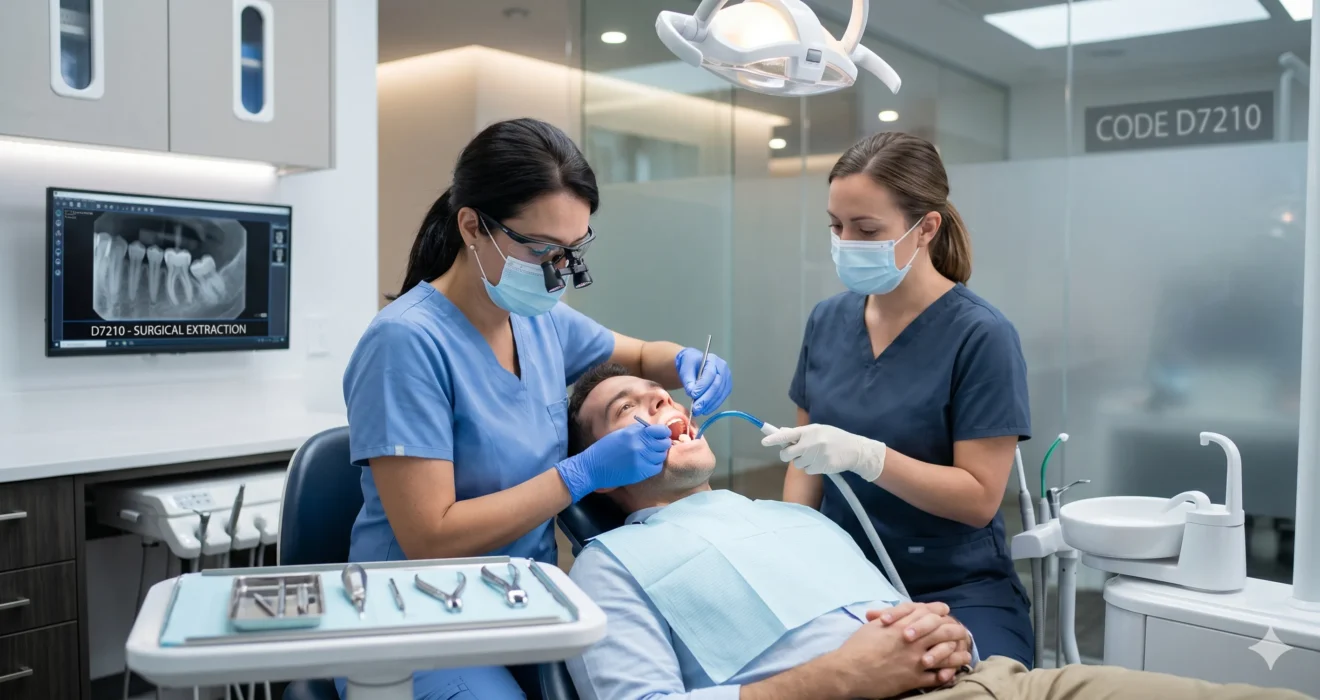
The D7210 dental code describes a surgical extraction of an erupted tooth. The American Dental Association defines it as a procedure requiring removal of bone, sectioning of the tooth, or both. Dentists may also elevate a mucoperiosteal flap during this process when the case calls for it. This makes D7210 more involved than a standard extraction, and insurers treat it differently for reimbursement purposes.
Many people assume D7210 applies to impacted teeth, but that assumption is incorrect. Impacted-tooth extractions fall under separate codes, including D7220, D7230, and D7240. D7210 only applies to teeth that have already erupted through the gum line. The complexity comes from the surgical technique, not from the tooth’s position below the surface.
A dentist typically chooses D7210 when a tooth resists removal through normal forceps technique. Dense bone, curved roots, or a fractured crown can all complicate a routine extraction. In these cases, the dentist must cut into bone or split the tooth into pieces to remove it safely. That extra surgical step is exactly what separates D7210 from a basic extraction code.
Documentation matters enormously here. Clinical notes must clearly state that bone removal or tooth sectioning occurred during the procedure. Without that detail, insurers may downgrade the claim to a simpler code and reduce payment. Dental teams should train clinicians to write detailed, code-specific notes immediately after every surgical extraction.
Reimbursement rates for D7210 generally run higher than rates for simple extractions. Insurers recognize the added time, skill, and surgical risk involved in this procedure. Practices that document thoroughly and bill accurately tend to see fewer denials and faster payments. Understanding this code protects both the practice’s revenue and the patient’s trust in the billing process.
Patients often ask why their extraction cost more than a friend’s simple extraction. Explaining the D7210 distinction in plain language helps set realistic expectations before treatment begins. A short conversation about why the tooth requires surgical removal goes a long way toward preventing billing disputes later.
D7210 vs. D7140 and Impacted Tooth Codes: Key Differences
Confusing D7210 with neighboring codes is one of the most common billing errors dental offices make. Here’s how to tell them apart quickly.
D7210 vs. D7140
D7140 covers a routine extraction of an erupted tooth or an exposed root, with no bone removal and no sectioning. D7210 applies only when the dentist must remove bone, section the tooth, or both. The tooth’s position is the same in both cases — what differs is the technique required to remove it.
- D7140: Simple forceps extraction, no flap, no bone removal
- D7210: Surgical extraction, flap elevation possible, bone removal and/or sectioning required
- Reimbursement: D7210 typically pays more due to added complexity
D7210 vs. Impacted Tooth Codes (D7220–D7241)
Impacted tooth codes apply only when the tooth has not fully erupted. These codes are categorized by how much bone or soft tissue covers the tooth:
- D7220 – Soft tissue impaction only
- D7230 – Partial bony impaction
- D7240 – Complete bony impaction
- D7241 – Complete bony impaction with unusual surgical complications
Unlike D7210, these codes have nothing to do with whether bone removal occurred for an erupted tooth. They describe impaction depth instead. Never substitute D7210 for an impacted-tooth code, even if the procedure feels equally complex to the clinical team.
When Should a Dentist Use D7210? Clinical Criteria and Documentation
Selecting the right code starts with reviewing the operative notes carefully. The procedure must meet specific clinical criteria before D7210 applies.
- Confirm the tooth was fully erupted. If any portion of the tooth remained unerupted, an impacted-tooth code likely applies instead.
- Verify bone removal or sectioning occurred. The dentist must have physically removed bone or cut the tooth into sections during the procedure.
- Check for flap elevation. While not always required, many D7210 cases involve elevating a mucoperiosteal flap to access the tooth.
- Review the reason for surgical intervention. Dense bone, curved or fused roots, and fractured crowns are common reasons that justify the surgical approach.
- Document everything in the chart. Operative notes should specify exactly what made a simple extraction impossible.
Clear documentation protects the practice during insurance audits. Adjusters frequently request operative notes before approving D7210 claims, especially for higher-fee submissions. A well-written note that names the specific complication — such as “heavy bone coverage prevented forceps removal” — gives the claim a strong foundation.
It also helps to record the tooth number, the date of service, and any radiographic evidence supporting the surgical decision. Thorough notes today prevent denied claims and frustrating appeals tomorrow.
D7210 Billing and Insurance Reimbursement Tips
Billing accuracy depends on more than picking the right code. The supporting paperwork has to match the clinical reality of the procedure.
Before submitting a D7210 claim, dental teams should confirm a few essentials:
- Verify insurance benefits and any waiting periods for surgical extractions before treatment begins
- Attach radiographs or intraoral photos that show the complexity of the case
- Include detailed narrative notes describing bone removal or tooth sectioning
- Match the correct tooth number on both the chart and the claim form
- Submit promptly to avoid timely-filing denials from the payer
Some insurers require a separate medical claim when oral surgery overlaps with medical necessity, particularly for trauma cases or infection-related extractions. Attaching the medical Explanation of Benefits to the dental claim can speed up reimbursement in these situations.
It also helps to know what D7210 already includes, so practices avoid billing for services twice. Routine elements like suture placement, suture removal, limited bone smoothing, and standard follow-up visits are bundled into the D7210 fee. Billing these separately can trigger a claim denial or an audit flag.
If alveoloplasty (bone reshaping) happens during the same visit as a single extraction, it generally falls under the D7210 fee as well. Separate alveoloplasty codes apply only when multiple extractions occur in the same area or when extensive bone recontouring is medically necessary beyond the extraction itself.
Common D7210 Coding Mistakes and How to Avoid Them
Even experienced billing teams slip up on this code. Watching for these patterns can save practices significant revenue.
- Using D7210 for every extraction by default. Some offices treat D7210 as the “go-to” surgical code without confirming bone removal actually occurred. This habit invites denials and potential audit findings.
- Forgetting to document flap elevation or bone removal explicitly. Vague notes like “tooth extracted” rarely satisfy insurance reviewers.
- Billing suture placement as a separate line item. Sutures are part of the D7210 procedure and should never appear as an additional charge.
- Mixing up D7210 with impacted-tooth codes. Always confirm eruption status before selecting a code, since impaction changes the entire billing category.
- Skipping radiographic support. Photos and X-rays strengthen the claim and reduce the chance of a request for additional information.
- Failing to update coding knowledge. CDT codes change periodically, and outdated billing software can apply incorrect fee schedules or descriptions.
Training front-office staff on these specific pitfalls reduces denial rates significantly. Many practices benefit from a quarterly internal audit of surgical extraction claims to catch recurring errors early. A small investment in staff training pays for itself through faster, more reliable reimbursements.
Conclusion
The D7210 dental code plays a critical role in accurate billing for surgical extractions of erupted teeth. It differs clearly from D7140 and from impacted-tooth codes like D7220 through D7241, and mixing these up remains one of the most frequent coding errors in dental offices. Correct use depends on confirming eruption status, documenting bone removal or sectioning, and supporting every claim with clear clinical notes. Practices that train their teams on these distinctions see fewer denials, faster payments, and stronger trust from patients who understand exactly what they’re paying for. Mastering this one code can make a measurable difference in a practice’s overall billing accuracy and revenue cycle.