
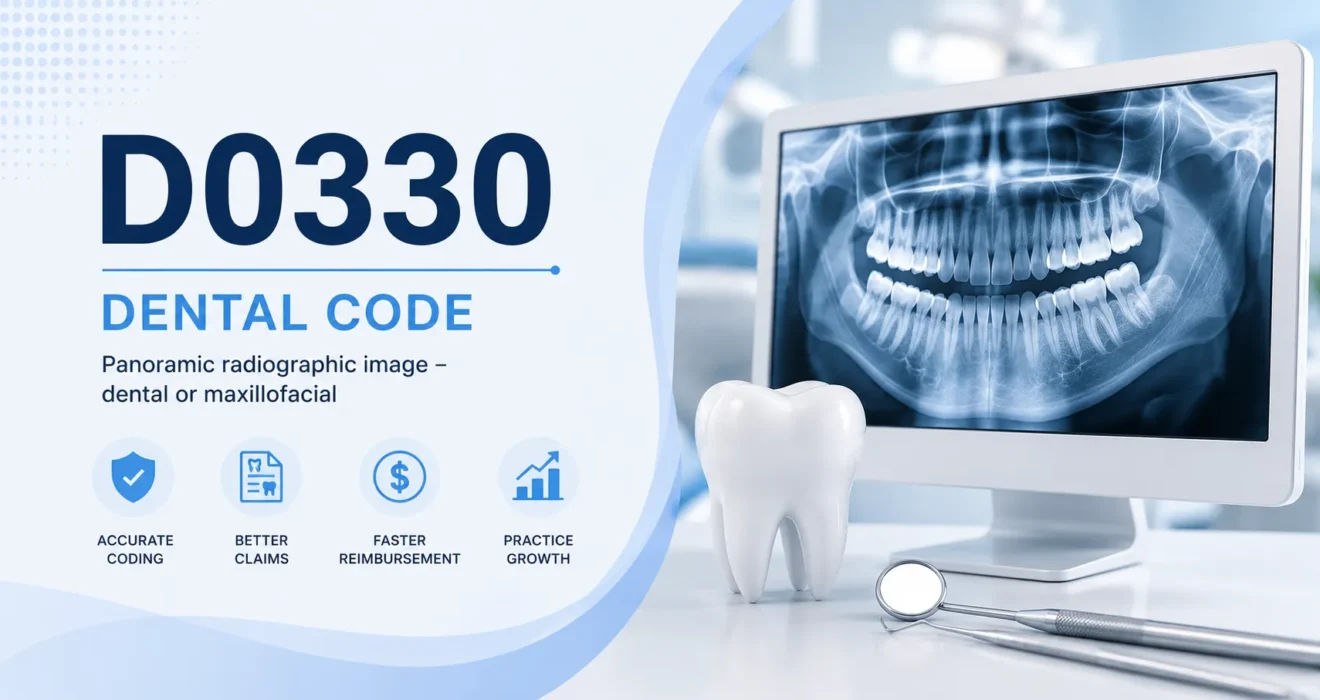
D0330 Dental Code: Panoramic X-Ray Billing Guide
Dental billing involves dozens of codes, and one causes more confusion than most: the D0330 dental code. This code covers a panoramic radiographic image, often called a pano. Front-desk teams and billers ask the same questions again and again. When should a practice use D0330? How does it differ from a full mouth series? What documentation does it need for payment?
Getting these answers wrong leads to denied claims, delayed reimbursement, and frustrated patients. This guide breaks down everything your dental practice needs to know about the D0330 dental code. You will learn the official definition, proper use cases, billing rules, and documentation requirements. By the end, your team can submit cleaner claims and avoid the most common reasons payers reject this code.
What Is the D0330 Dental Code? Understanding the Definition
The D0330 dental code is the official CDT code for a panoramic radiographic image. Dentists and patients usually call it a panoramic X-ray, or simply a “pano.” It is an extraoral procedure, which means the imaging device captures the picture from outside the mouth rather than inside it.
The machine rotates around the patient’s head during the exposure. This rotation produces one continuous, curved image that shows both jaws, all teeth, the sinuses, the nasal area, and the temporomandibular joints. A single exposure replaces what would otherwise require many smaller intraoral films.
D0330 sits within the Diagnostic Imaging category of the CDT code set, which the American Dental Association maintains and updates every year. It shares this category with other radiograph codes, including periapical images, bitewings, and cone beam CT scans. Each code describes a distinct type of image, and payers expect practices to match the code exactly to the procedure performed.
The panoramic view gives dentists broad anatomical context in one glance. A single image can reveal impacted wisdom teeth, jaw growth patterns, sinus irregularities, and joint problems without the need for several separate films. This efficiency makes D0330 one of the most frequently billed radiograph codes in general dentistry.
That said, a panoramic image has real limitations. It produces lower resolution than periapical films, and anterior teeth often overlap on the image. For this reason, D0330 cannot replace a detailed periapical view when a dentist needs to examine one tooth closely.
Understanding this exact definition matters for billing accuracy. Confusing D0330 with a full mouth series or a cone beam CT code is a common and costly mistake. Knowing precisely what D0330 includes protects your practice from coding errors, compliance issues, and avoidable claim denials.
When Should Dentists Use
Not every patient visit calls for a panoramic image. Insurers expect a documented clinical reason before they reimburse this procedure, so understanding the right scenarios matters just as much as understanding the definition.
Common Clinical Scenarios for a Panoramic X-Ray
Dentists typically order a pano for these situations:
- New patient screening evaluations that require a broad overview of oral structures
- Third molar (wisdom teeth) assessment before extraction or referral
- Orthodontic treatment planning, including monitoring jaw and tooth development
- Trauma or injury evaluation following an accident or impact
- Implant planning, where the dentist needs to assess bone structure and nerve position
- Screening for cysts, tumors, or other jaw pathology
- Patients who cannot tolerate intraoral films, including young children, patients with a strong gag reflex, or patients with special needs
Why Clinical Necessity Matters
Insurance payors will not reimburse D0330 simply because a practice took the image as a routine step. They look for a specific, documented reason tied to that patient’s evaluation. A dentist must order the panoramic image based on individual clinical findings, not as a standing protocol applied to every new patient. Skipping this step is one of the fastest ways to trigger a claim denial.
D0330 vs. Other Dental X-Ray Codes: Key Differences
Many denials happen because a practice bills the wrong radiograph code for the image actually taken. Comparing D0330 against nearby codes helps your team choose correctly every time.
How D0330 Compares to Other Radiograph Codes
- D0330 – Panoramic radiographic image: One extraoral exposure covering both jaws, all teeth, sinuses, and TMJ areas.
- D0210 – Intraoral comprehensive series: A full mouth series of 14 to 22 individual periapical and bitewing films.
- D0220 and D0230 – Periapical images: D0220 covers the first periapical image, and D0230 covers each additional one.
- D0250 – Extraoral 2D stationary radiograph: A standard extraoral image, such as a lateral skull film, taken with a fixed sensor.
- D0364 through D0384 – Cone beam CT codes: These cover three-dimensional imaging, selected by field of view, and should never be substituted with D0330.
Why Mixing These Codes Causes Denials
Payers cross-check the billed code against the actual image type. Submitting D0330 for a CBCT scan, or billing it alongside D0210 without justification, almost always results in a rejected claim. Many plans also treat D0330 and D0210 as alternates rather than additive procedures, meaning a recent full mouth series can block a new panoramic claim within the same benefit window, and the reverse is also true.
How to Bill the D0330 Dental Code Correctly
Clean claims for D0330 depend on getting three core elements right every time.
Three Elements Every Clean Claim Needs
A successful D0330 claim rests on clinical necessity, accurate documentation, and correct code pairing. Clinical necessity means the dentist ordered the image after evaluating the patient, not as routine practice. Accurate documentation means the chart clearly explains why the image was required. Correct code pairing means D0330 stands alone unless a specific payer policy allows bundling with another procedure on the same date.
Practices that consistently apply these three elements see far fewer denials and faster reimbursement cycles. Skipping even one of them increases the risk of a rejected claim, an audit flag, or a delayed payment.
Frequency Limitations to Check Before Billing
Most dental plans place a frequency limitation on panoramic imaging, commonly allowing one D0330 every three to five years unless medical necessity justifies an earlier image. Before scheduling a panoramic X-ray, your team should verify the patient’s last D0330 and D0210 dates. This single check prevents a large share of avoidable denials tied to frequency overlap.
Documentation Checklist
Strong documentation is the strongest defense against a denied or audited claim. Payers want to see a clear story connecting the patient’s symptoms to the decision to take a panoramic image.
What Your Clinical Notes Should Include
Every chart entry supporting a D0330 claim should reflect a clear order from the dentist, specific clinical findings that justify the image, and the diagnostic purpose behind the procedure. A vague note that simply states “panoramic taken” rarely satisfies a payer’s review.
A stronger note describes the patient’s presenting complaint, the clinical exam findings, and the reason the dentist chose a panoramic view over other imaging options. It should also note any follow-up plan, such as a referral to an oral surgeon or a recommendation for further imaging. This level of detail leaves little room for a payer to question medical necessity.
Practices that build this habit into their charting workflow tend to experience smoother claim approvals and far fewer appeal letters.
Common Mistakes That Get D0330 Claims Denied
Even experienced billing teams occasionally fall into avoidable traps with this code. Recognizing the common patterns helps your practice correct them before they affect revenue.
Billing Errors to Avoid
- Billing D0330 and D0210 on the same date without payer-specific justification
- Using D0330 to report a cone beam CT image instead of the correct CBCT code
- Submitting a claim without documenting the specific clinical reason for the image
- Ignoring the plan’s frequency limitation between panoramic images
- Failing to attach the image when a payer requests it during adjudication
How to Prevent These Issues
Most of these errors share a common fix: verify before you bill. Confirm the patient’s imaging history, match the code to the actual procedure performed, and ensure the clinical note supports the decision. A short pre-submission review catches the majority of issues before they ever reach the payer.
Final Thoughts
The D0330 dental code plays an important role in modern dental diagnostics, giving practices a fast, broad view of a patient’s oral structures in a single image. Used correctly, it supports better treatment planning, earlier detection of problems, and stronger patient outcomes.
Billing it correctly depends on three habits: confirming genuine clinical necessity, documenting that necessity clearly, and matching the code precisely to the image taken. Practices that build these habits into daily workflow see fewer denials, faster reimbursement, and less time spent on appeals. Treat every D0330 dental code claim as an opportunity to demonstrate clean, defensible billing, and your practice will see the difference in both compliance and cash flow.