D0150 Dental Code Explained: The Complete Billing Guide
If you work in a dental office, you have billed the D0150 dental code more times than you can count — yet the rules around it still trip up even experienced teams. This single CDT code decides whether a visit gets reimbursed as a full diagnostic workup or gets bounced back as a duplicate claim. Getting it right protects your revenue and keeps patients from receiving surprise bills. In this guide, we break down what D0150 actually means, when you should (and shouldn’t) use it, what it must include, and how it stacks up against similar codes like D0120 and D0180. By the end, you will be able to bill this code with confidence every single time.
What Is the D0150 Dental Code?
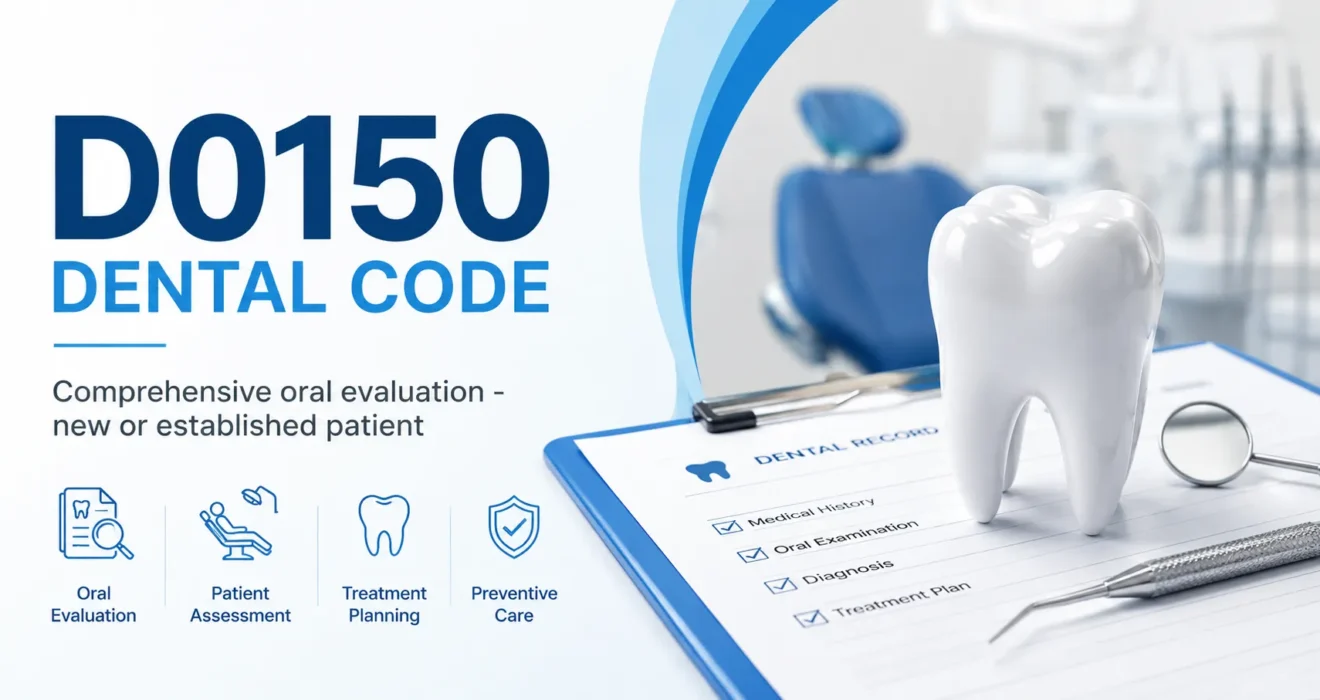
D0150 is the CDT (Current Dental Terminology) code for a comprehensive oral evaluation, and the American Dental Association maintains and updates it as part of its annual code set review. Dentists use this code to describe a deep, first-look style assessment rather than a quick routine checkup. It signals to an insurance carrier that the visit involved far more than a glance inside the mouth.
The evaluation tied to this code covers a full review of the patient’s medical and dental history, an extraoral and intraoral examination of hard and soft tissue, and a dedicated oral cancer screening. It also typically involves checking existing restorations, missing or unerupted teeth, occlusal relationships, and periodontal conditions where appropriate. Because the scope is so broad, this code sits at a higher reimbursement tier than a periodic exam.
Despite its name, D0150 is not reserved only for brand-new patients walking through the door for the first time. Established patients can qualify too, provided certain conditions are met. This is one of the most common points of confusion in dental billing, and it is exactly why so many claims for this code get flagged or denied.
The goal behind this evaluation is diagnostic, not cosmetic. The dentist is building a complete picture of the patient’s oral health so that an accurate diagnosis and treatment plan can follow. Think of it as the baseline against which every future visit gets measured.
Because the documentation requirements are strict, billing teams need clinical notes that clearly justify the comprehensive nature of the visit. A vague note that simply says “exam performed” will not hold up if a payer requests records. Specificity is what separates a paid claim from a downgraded one.
Understanding this code thoroughly is the first step toward cleaner claims, fewer denials, and a healthier revenue cycle for your practice.
When Should You Use D0150? Eligibility Rules Every Practice Should Know
Knowing who qualifies for this code is just as important as knowing what it covers. The ADA descriptor lays out specific scenarios where billing D0150 is appropriate, and going outside those scenarios is the fastest way to trigger a denial.
Patients Who Typically Qualify
- A patient visiting your practice for the very first time
- An established patient with a significant change in their health condition since their last visit
- A patient returning after being absent from active treatment for three or more years
- A returning patient presenting with unusual circumstances that require detailed documentation (“by report”)
Patients Who Generally Do Not Qualify
- A patient coming in for a routine, six-month checkup with no notable changes
- A patient who already had a comprehensive evaluation within the carrier’s lookback window
- A patient seeking a problem-focused visit, such as an emergency appointment
If a patient falls outside these categories, the periodic oral evaluation code, D0120, is usually the correct choice instead. Mixing this up is one of the leading causes of claim downgrades industry-wide.
What’s Included in a D0150 Comprehensive Oral Evaluation
A true comprehensive evaluation is not a single quick task — it is a structured sequence of clinical steps that the dentist works through during the appointment. Here is the typical order of operations:
- Review the patient’s full medical and dental history, including medications, allergies, and prior treatments.
- Conduct an oral cancer screening, examining soft tissue for abnormalities or lesions.
- Examine hard and soft tissues, both extraorally and intraorally, for signs of disease or damage.
- Assess existing restorations and prostheses, checking for wear, decay, or failure.
- Evaluate occlusal relationships and periodontal conditions, including screening or charting where indicated.
- Document findings and build a treatment plan based on everything observed during the visit.
This is not an exhaustive checklist that must be completed in full every time — some elements, like periodontal charting, are included only when clinically indicated. But the core diagnostic steps above must be present to justify billing D0150 instead of a lighter exam code.
D0150 vs D0120 vs D0180: Spotting the Differences
Three exam codes get confused more than any others in dental billing, so let’s separate them clearly.
D0150 (Comprehensive Oral Evaluation) is the broadest of the three. It applies to new patients and to established patients who meet specific conditions, such as a long absence from care or a major health change. It builds the foundation for a full treatment plan.
D0120 (Periodic Oral Evaluation) is the routine, everyday exam. It applies to established patients coming in for a standard recall visit to check for changes since their last comprehensive or periodic evaluation. It is not a substitute for D0150 when a patient genuinely needs a full diagnostic workup.
D0180 (Comprehensive Periodontal Evaluation) narrows its focus specifically to periodontal health. It requires full-mouth periodontal charting and is used when a patient shows signs of gum disease or carries risk factors such as diabetes or smoking. Importantly, D0180 should not be billed on the same visit as D0150 by the same provider.
The easiest way to remember the distinction: D0150 looks at the whole mouth in depth, D0120 checks for changes since last time, and D0180 zeroes in on gum health specifically.
Insurance, Frequency Limits, and Billing Tips for D0150
Insurance carriers do not pay D0150 on demand — they apply frequency limits, and understanding those limits is essential to getting reimbursed.
Typical Frequency Rules
- Most carriers allow D0150 once every three to five years per patient, per provider.
- A small number of plans treat it as a one-time, lifetime benefit — after that, every future exam is billed as D0120.
- Frequency is usually tracked per provider, meaning a patient switching practices is often still eligible for a fresh D0150 at the new office.
It’s worth noting that frequency limits are a payer policy issue, not a clinical coding issue. You should still bill D0150 if it was clinically performed, even if you suspect the claim might be denied for frequency reasons — in that case, requesting an alternate benefit under D0120 is the standard workaround.
Before You Submit the Claim
- Verify the patient’s insurance benefits and exam history.
- Attach complete clinical documentation, including any supporting X-rays.
- Add a short narrative if the situation involves unusual circumstances or a significant health change.
Following these steps consistently reduces back-and-forth with payers and speeds up your reimbursement timeline considerably.
Common D0150 Billing Mistakes (and How to Avoid Claim Denials)
Even well-run practices fall into a handful of predictable traps with this code. Recognizing them ahead of time can save your front office hours of rework.
The Most Frequent Errors
- Billing too soon after a previous comprehensive evaluation, before the carrier’s lookback window has reset
- Using D0150 for a routine checkup that should have been billed as D0120 instead
- Submitting thin documentation that doesn’t clearly show why the visit was comprehensive rather than periodic
- Billing D0150 and D0180 together on the same date of service, which most carriers will reject
- Assuming a “new patient” exam always qualifies, even when the patient was recently seen elsewhere
Avoiding these pitfalls comes down to one habit: matching the clinical reality of the visit to the code’s actual requirements every single time, rather than defaulting to whichever code feels familiar.
Conclusion
The D0150 dental code carries real weight in a practice’s revenue cycle, but it only pays off when it’s used the way it was designed to be used. It belongs to new patients, patients returning after a long gap, and established patients facing a meaningful health change — not to every routine visit that walks through the door. By documenting thoroughly, understanding how this code differs from D0120 and D0180, and staying aware of each carrier’s frequency limits, your team can submit cleaner claims and see fewer denials. Treat this guide as a quick reference the next time your front desk or billing team needs to double-check whether D0150 is the right call.